


 Call us:
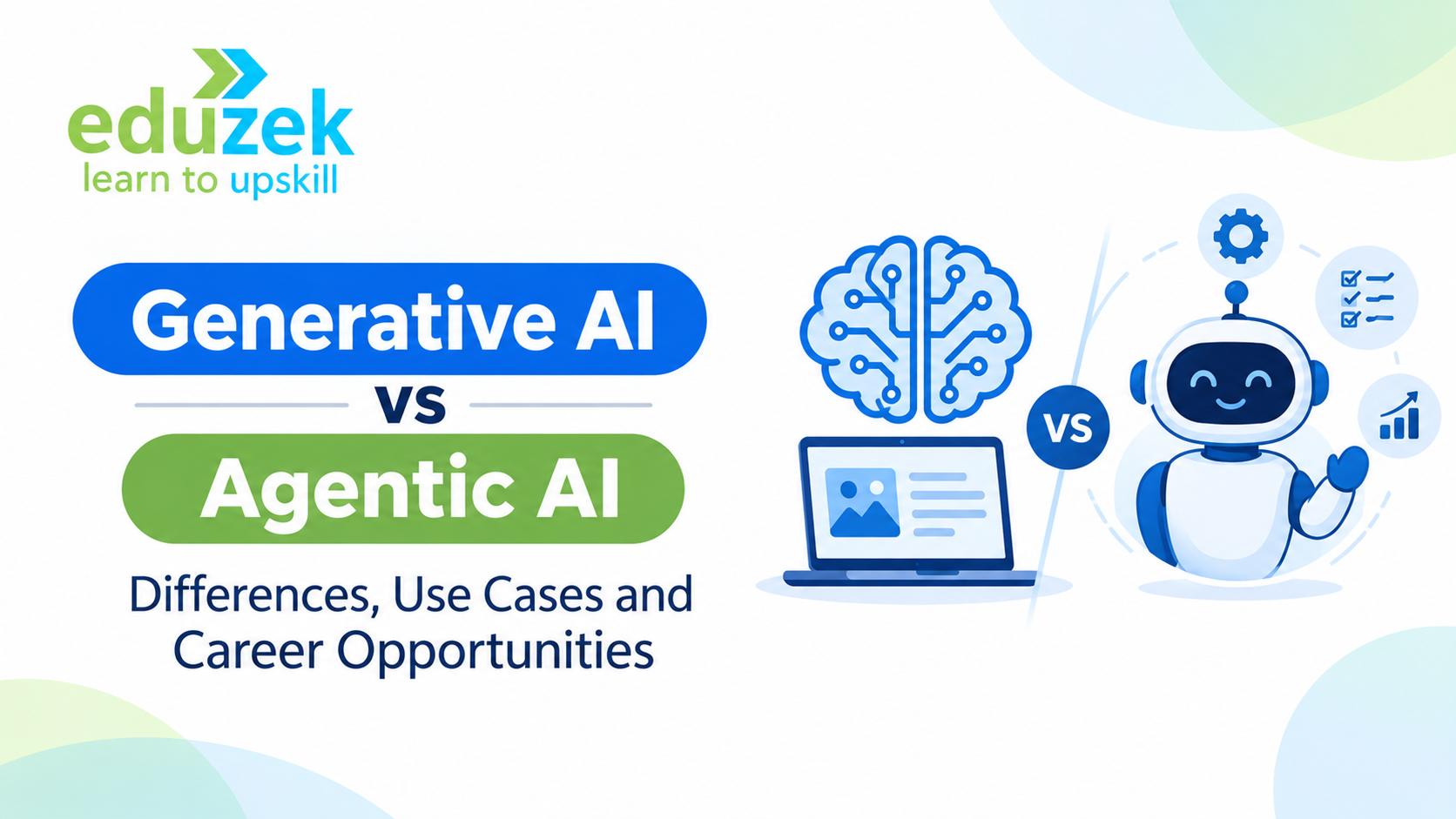
Generative AI vs Agentic AI: Differences, Use Cases and Career Opportunities
Generative AI vs Agentic AI: Differences, Use Cases and Career Opportunities
Artificial Intelligence is evolving rapidly, changing how businesses operate, how professionals work and how technology solutions are developed. From generating marketing content and writing code to automating business processes and managing complex workflows, AI is becoming an essential part of modern organisations.
Two important developments in this space are Generative AI and Agentic AI.
Although these technologies are closely related, they serve different purposes. Generative AI primarily focuses on creating new content, such as text, images, code and summaries, based on user instructions. Agentic AI goes a step further by enabling AI systems to plan tasks, make decisions, interact with external tools and execute multi-step workflows to achieve specific objectives.
For example, a Generative AI application can write an email based on a user's instructions. An Agentic AI system can potentially understand the objective, retrieve relevant information, draft the email, check the recipient details and initiate an approved sending workflow.
This difference is creating new opportunities for developers, data professionals, software engineers and working professionals interested in building intelligent applications.
Understanding Generative AI vs Agentic AI is therefore important for anyone planning to enter the artificial intelligence industry or upgrade their existing technical skills.
In this guide, we will explore how both technologies work, their key differences, practical applications, required skills and career opportunities. We will also discuss which technology beginners should learn first and how to choose a structured learning path.
1. What Is Generative AI?
Generative AI is a category of artificial intelligence that can create new content based on patterns learned from large datasets.
Unlike traditional AI systems that primarily classify information, identify patterns or make predictions, Generative AI models can produce original outputs in response to user instructions.
These outputs may include:
- Text and articles.
- Images and illustrations.
- Computer code.
- Audio and speech.
- Videos.
- Summaries and reports.
- Translations.
- Product descriptions and marketing content.
Generative AI systems are generally powered by machine learning models, particularly deep learning architectures such as transformers and large language models (LLMs).
These models learn relationships between data elements during training and use that knowledge to generate relevant responses.
How Does Generative AI Work?
Generative AI works through a process involving training data, model learning, user prompts and content generation.
The basic workflow includes:
Step 1: Data Collection
The model is trained using large datasets containing text, images, code, audio or other types of information, depending on its intended purpose.
Step 2: Model Training
Machine learning algorithms identify patterns, relationships and structures within the training data.
For example, a language model learns how words and sentences are connected and how different types of questions are generally answered.
Step 3: User Prompt
The user provides an instruction or question known as a prompt.
For example:
"Write a professional email explaining a project delay to a client."
Step 4: Processing the Prompt
The model interprets the input using its learned patterns and the context provided in the conversation.
Step 5: Content Generation
The model generates a response based on the prompt.
Step 6: User Review
The user evaluates the generated output and may request modifications, additional information or a different format.
Examples of Generative AI Applications
Generative AI is already being used across several industries.
Content Creation: Marketing teams use AI to create blog outlines, social media captions, product descriptions and email campaigns.
Software Development: Developers use AI coding assistants to generate code, explain programming concepts, identify errors and suggest improvements.
Customer Support: Businesses use AI-powered chatbots to answer frequently asked questions and provide conversational support.
Education: Students and professionals use AI applications to understand complex subjects, summarise learning materials and generate practice questions.
Design and Media: Creative professionals use image-generation tools to develop visual concepts, illustrations and marketing creatives.
Business Productivity: Employees use AI to summarise documents, prepare reports, analyse information and improve everyday workflows.
Generative AI is particularly useful when the primary requirement is to create, transform, summarise or interpret information.
2. What Is Agentic AI?
Agentic AI refers to AI systems designed to work towards specific goals by planning tasks, making decisions, using tools and executing actions with varying levels of autonomy.
Instead of simply generating a response to a prompt, an Agentic AI system can determine the steps required to complete a task and perform those steps through connected tools and services.
An AI agent may receive an objective, break it into smaller tasks, retrieve information, evaluate results and decide what action to take next.
For example, consider a business that wants to automate customer enquiry management.
A traditional chatbot may answer a customer's question about a product.
An Agentic AI system could potentially:
- Receive a customer enquiry.
- Understand the customer's requirement.
- Retrieve relevant customer information.
- Search the product database.
- Identify suitable product options.
- Prepare a personalised response.
- Update the customer relationship management system.
- Escalate the enquiry to a human employee when necessary.
The exact capabilities depend on the agent's tools, permissions, system design and level of autonomy.
How Does Agentic AI Work?
Agentic AI systems generally combine several components to perform tasks.
1. Large Language Models (LLMs)
LLMs act as the reasoning and language-processing component of many AI agents. They help interpret instructions, understand context and determine possible next steps.
2. Goal Understanding
The agent receives a specific objective and identifies what needs to be achieved.
3. Planning and Task Breakdown
Complex objectives are divided into smaller tasks.
For example, an agent asked to prepare a sales report may need to retrieve sales data, calculate performance metrics, identify trends and generate a summary.
4. Tool Calling
The agent interacts with external applications, APIs, databases and other tools to complete tasks.
5. Memory and Context Management
Memory mechanisms help an agent retain relevant information during a workflow or across interactions, depending on the system's architecture.
6. Action Execution
The agent performs actions such as retrieving records, updating information, creating documents or initiating workflows, subject to its permissions.
7. Evaluation and Feedback
The agent evaluates the results of its actions and determines whether additional steps are required.
This process may involve repeated cycles of reasoning, action and observation until the objective is achieved or the workflow requires human intervention.
Examples of Agentic AI Applications
Agentic AI has applications across different business functions.
- Customer Service: Agents can retrieve customer records, classify enquiries and initiate support workflows.
- Sales Automation: AI agents can research prospects, prepare personalised communication and update CRM records.
- IT Operations: Agents can investigate alerts, collect diagnostic information and recommend or execute approved remediation steps.
- Finance: Agents can gather financial information, categorise transactions and support reporting processes.
- Human Resources: Agents can assist with employee onboarding, document collection and internal HR workflows.
- Software Development: AI agents can analyse requirements, write code, run tests and assist with debugging.
- Research: Agents can gather information from multiple sources, organise findings and prepare structured reports.
Agentic AI is especially valuable when a business process involves multiple steps, different tools and decisions that need to be coordinated.
3. How Generative AI Systems Work
To understand the difference between Generative AI and Agentic AI, it is useful to examine how a typical Generative AI application operates.
Most Generative AI applications follow a prompt-and-response workflow.
The user provides information or instructions, the model processes the input and generates an output.
For example, a marketing professional may ask an AI application to create a social media campaign for a new product.
The application may generate:
- Campaign headlines.
- Social media captions.
- Advertising descriptions.
- Email content.
- Content ideas.
- Suggested hashtags.
The user can review the results and request further changes.
However, the application does not necessarily publish the campaign, schedule posts, analyse performance or modify the advertising account automatically.
Those actions require additional integrations and execution capabilities.
Important Components of Generative AI
Large Language Models
Large language models process and generate human-like text. They are commonly used in conversational AI applications, content-generation systems and coding assistants.
Prompt Engineering
Prompt engineering involves writing clear instructions to obtain relevant and useful outputs from AI models.
A well-structured prompt generally includes the objective, context, constraints and expected output format.
Context Windows
A context window determines how much information a model can process within a particular interaction.
Embeddings
Embeddings convert information into numerical representations that help systems identify semantic relationships between data.
Retrieval-Augmented Generation (RAG)
RAG combines information retrieval with generative models.
Instead of relying only on information learned during model training, a RAG application retrieves relevant information from an external knowledge source and provides it to the model as additional context.
For example, a company can build an internal knowledge assistant that retrieves information from company policies, documentation and approved business records before generating an answer.
Fine-Tuning
Fine-tuning involves adapting a pre-trained model using additional training data for a specific task or domain.
These concepts provide a foundation for developing more advanced AI applications and eventually working with Agentic AI systems.
4. How AI Agents Work
Agentic AI systems use many of the same underlying technologies as Generative AI but introduce additional capabilities for planning, tool interaction and action execution.
A key difference is that an AI agent is generally designed around an objective rather than a single response.
Consider an example where a business wants to automate the process of preparing a weekly sales performance report.
A basic Generative AI application can summarise sales data provided by the user.
An AI agent can potentially perform a larger workflow:
Step 1: Understand the Objective
The agent receives the instruction to prepare a weekly sales report.
Step 2: Identify Required Information
It determines which sales records, reporting periods and performance metrics are required.
Step 3: Retrieve Data
The agent connects to an authorised database, CRM system or other data source.
Step 4: Analyse Information
It calculates relevant metrics, identifies trends and compares performance.
Step 5: Generate the Report
The agent prepares a structured report containing important findings.
Step 6: Execute the Next Action
Depending on its permissions, it may save the report or initiate an approved notification workflow.
Step 7: Review the Outcome
The system checks whether the requested task has been completed successfully.
Key Technologies Behind Agentic AI
Several technologies contribute to the development of AI agents.
- LLMs: Provide language understanding, reasoning and decision-support capabilities.
- Tool Calling: Allows agents to interact with external applications and services.
- APIs: Enable communication between AI agents and business systems.
- Memory: Helps retain relevant context and information.
- RAG: Provides access to external knowledge sources.
- Planning: Helps break complex objectives into manageable tasks.
- Agent Frameworks: Provide components for developing, coordinating and managing agent workflows.
- Evaluation: Helps measure whether an agent is producing reliable results.
Understanding these technologies is important for professionals who want to move beyond basic AI usage and develop practical AI-powered applications.
5. Generative AI vs Agentic AI: Key Differences
Although Generative AI and Agentic AI share several underlying technologies, their objectives, capabilities and workflows are different.
Generative AI primarily focuses on producing content based on user instructions, whereas Agentic AI focuses on achieving objectives through planning, tool usage and action execution.
The following comparison explains the differences.
Generative AI vs Agentic AI Comparison Table
| Comparison FactorGenerative AIAgentic AI | ||
| Primary Purpose | Generate new content | Achieve objectives through actions |
| Main Capability | Content creation and information processing | Planning, decision-making and task execution |
| Working Method | Primarily prompt-and-response | Goal-oriented, multi-step workflows |
| User Interaction | Usually responds to user instructions | Can independently determine and execute permitted next steps |
| Decision-Making | Generates suggestions and responses | Selects actions based on goals and context |
| Tool Usage | May use tools when integrated | Commonly relies on tools to complete tasks |
| Memory | Uses conversation context and model capabilities | May use short-term and persistent memory mechanisms |
| Workflow | Usually focuses on individual requests | Can coordinate multiple tasks |
| Examples | ChatGPT, image generators and AI writing tools | Research agents, workflow agents and autonomous support systems |
| Business Applications | Content creation, summarisation and coding assistance | Process automation, research and multi-step business workflows |
| Human Involvement | Often requires users to initiate and review individual tasks | Can operate with varying autonomy and human oversight |
| Required Skills | Prompt engineering, LLMs and RAG | LLMs, tool calling, APIs, memory and agent orchestration |
Understanding the Difference Through an Example
Imagine a company wants to manage customer support enquiries.
Generative AI Approach:
A customer asks a question about a product.
The AI application understands the question and generates an appropriate answer based on the information available to it.
Agentic AI Approach:
An AI agent receives a customer enquiry and may:
- Identify the customer's issue.
- Retrieve the customer's account information.
- Search the product documentation.
- Check the order status.
- Determine the appropriate response.
- Update the support ticket.
- Escalate the issue if required.
The agent performs a sequence of connected activities rather than simply generating an answer.
This illustrates why Agentic AI is considered an important development in the evolution of AI-powered business automation.
6. Examples of Generative AI Applications
Generative AI is already being adopted across industries because it can reduce the time required to create and process information.
Here are some practical applications.
1. AI Content Creation
Businesses use Generative AI to prepare articles, marketing content, social media posts, email campaigns and product descriptions.
Content teams can use AI to generate initial drafts and improve productivity while maintaining human review and editorial control.
2. AI-Powered Coding Assistants
Software developers use Generative AI tools to:
- Generate code snippets.
- Explain programming concepts.
- Identify potential errors.
- Suggest code improvements.
- Create test cases.
- Generate documentation.
3. Conversational AI Applications
Generative AI powers conversational applications that can answer questions, explain concepts and assist users with different tasks.
4. Document Summarisation
Professionals can use AI to summarise long documents, extract key points and prepare concise reports.
5. Image and Creative Generation
Designers and marketing teams can generate visual concepts, illustrations and creative assets using text-based instructions.
6. Personalised Learning
Educational platforms can use Generative AI to explain difficult topics, create quizzes and provide learning recommendations.
These applications demonstrate how Generative AI can support everyday work across technical and non-technical roles.
7. Examples of Agentic AI Applications
Agentic AI becomes particularly useful when applications need to interact with multiple systems and perform several connected activities.
1. Intelligent Customer Support Agents
An AI agent can classify customer enquiries, retrieve relevant information, check account details and update support tickets.
For more complex cases, it can transfer the conversation to a human support representative.
2. AI-Powered Sales Agents
Sales agents can assist with prospect research, customer information retrieval, lead qualification and CRM updates.
For example, an AI agent may collect information about a potential customer, prepare a lead summary and recommend suitable follow-up actions.
3. Research Agents
Research agents can collect information from authorised sources, organise findings, compare information and prepare structured summaries.
4. IT Support Automation
An AI agent can investigate technical alerts, retrieve system logs and recommend possible solutions.
With appropriate permissions and safeguards, it may also execute predefined remediation tasks.
5. Business Process Automation
Agentic AI can support workflows involving multiple departments, applications and approval stages.
For example, an agent may collect information for an employee onboarding process, identify missing documents and initiate the appropriate workflow.
6. Software Development Agents
AI development agents can assist with understanding requirements, generating code, running tests and identifying potential issues.
Human developers remain important for reviewing architecture, security, quality and production readiness.
8. How Generative AI and Agentic AI Work Together
Generative AI and Agentic AI should not always be considered competing technologies.
In fact, many Agentic AI applications depend on Generative AI models to perform language processing, interpret instructions and support decision-making.
Generative AI provides the content-generation and language capabilities, while the agent architecture enables the system to use those capabilities to complete larger objectives.
Consider an AI-powered recruitment workflow.
A Generative AI model may help:
- Write job descriptions.
- Summarise candidate profiles.
- Generate interview questions.
- Prepare candidate communication.
An Agentic AI system may coordinate the larger workflow:
- Receive a recruitment requirement.
- Retrieve relevant candidate information from authorised systems.
- Compare candidate profiles against defined criteria.
- Prepare candidate summaries.
- Organise interview-related information.
- Initiate approved scheduling workflows.
- Update recruitment records.
The language model supports several tasks, while the agent coordinates the overall process.
Why This Combination Matters
Combining Generative AI and Agentic AI can help businesses:
- Reduce repetitive manual activities.
- Improve information processing.
- Connect multiple business applications.
- Support complex workflows.
- Improve employee productivity.
- Develop more intelligent digital services.
However, effective implementation requires appropriate permissions, data protection, human oversight and reliable system design.
9. Skills Needed to Work with Generative AI
Professionals interested in Generative AI should develop a combination of technical knowledge and practical application skills.
The required depth depends on whether the goal is to use existing AI applications, build AI-powered solutions or develop machine learning systems.
1. Python Programming
Python is widely used in AI development because of its extensive ecosystem of libraries and frameworks.
Basic Python knowledge helps professionals work with APIs, process information and develop AI applications.
2. Understanding Large Language Models
Learners should understand:
- What LLMs are.
- How language models work at a high level.
- Model inputs and outputs.
- Tokens and context windows.
- Model limitations.
- Common applications of LLMs.
3. Prompt Engineering
Prompt engineering helps users provide clear instructions and obtain more useful outputs.
Important concepts include:
- Role-based prompting.
- Context-based prompting.
- Few-shot prompting.
- Structured output generation.
- Prompt evaluation.
- Prompt refinement.
4. Working with AI APIs
Developers should understand how to connect AI models with applications using APIs.
This includes handling requests, responses, authentication and errors.
5. Retrieval-Augmented Generation
RAG is an important concept for building AI applications that need to retrieve information from external knowledge sources.
Professionals should understand document processing, embeddings, retrieval, vector databases and context injection.
6. AI Application Development
Learners should gain practical experience in building applications such as:
- AI chatbots.
- Document summarisation tools.
- Knowledge assistants.
- AI-powered content applications.
- Question-answering systems.
Professionals looking to develop these capabilities can explore Eduzek's Generative AI Course Training in India to understand the learning opportunities available for developing Generative AI skills.
10. Skills Needed to Build Agentic AI Systems
Building Agentic AI applications requires a broader understanding of AI development because agents need to interact with external systems, manage workflows and execute tasks.
The following skills provide a useful foundation.
1. Python Programming
Python is commonly used to build AI agents, integrate APIs and manage application logic.
Professionals should understand functions, classes, modules, error handling and working with external libraries.
2. Large Language Models
Understanding LLMs is essential because many AI agents use them to interpret objectives, process information and determine possible actions.
3. Tool Calling and Function Calling
Tool calling enables AI models to interact with external functions and applications.
For example, an AI agent may call a function to retrieve customer information from a database or check the availability of a product.
Developers should understand:
- Function definitions.
- Tool descriptions.
- Input parameters.
- Structured outputs.
- API integrations.
- Error handling.
4. Agent Planning and Reasoning
AI agents need mechanisms to break larger objectives into smaller tasks.
Developers should understand how agents select actions, maintain task context and handle situations where an initial approach does not work.
5. Memory Management
Memory helps agents retain relevant information throughout a workflow.
Common concepts include:
- Short-term memory.
- Long-term memory.
- Conversation history.
- Context management.
- External memory storage.
6. Retrieval-Augmented Generation
RAG allows agents to access relevant information from external documents, databases and knowledge sources.
This is especially useful when building enterprise AI applications that depend on organisation-specific information.
7. APIs and System Integrations
Agents frequently interact with external applications.
Understanding REST APIs, authentication, JSON and application integrations is therefore important.
8. Agent Development Frameworks
Frameworks can simplify the development and management of AI agents.
Depending on the learning programme and project requirements, professionals may explore frameworks such as LangChain and LangGraph.
9. Multi-Agent Systems
Some applications use multiple specialised agents that collaborate to achieve a larger objective.
For example, a research workflow may include separate agents for information gathering, analysis and report preparation.
10. Testing and Evaluation
Agentic AI systems require careful testing because they can execute actions and interact with business applications.
Developers should understand:
- Output evaluation.
- Tool execution testing.
- Workflow validation.
- Error recovery.
- Security controls.
- Human approval mechanisms.
Working professionals interested in developing these capabilities can explore Eduzek's GenAI and Agentic AI Training for Working Professionals to learn more about relevant training opportunities.
11. Career Opportunities in Generative AI
The increasing adoption of AI is creating opportunities across software development, business automation, data analysis and technology consulting.
Generative AI knowledge can be valuable for both technical and non-technical professionals.
Some relevant career roles include:
1. Generative AI Developer
Generative AI developers build applications powered by large language models and other generative technologies.
Typical responsibilities include developing AI-powered applications, integrating models through APIs and implementing prompt-based workflows.
2. AI Application Developer
AI application developers integrate artificial intelligence capabilities into software products and business applications.
They may work on chatbots, document-processing systems, knowledge assistants and intelligent automation solutions.
3. Prompt Engineer
Prompt engineers design, test and refine instructions used by AI models to improve output quality and consistency.
They may work with content generation, conversational applications and AI-powered business tools.
4. RAG Developer
RAG developers build applications that combine information retrieval with language models.
Their work may involve document processing, embeddings, vector databases and retrieval pipelines.
5. AI Solutions Consultant
AI solutions consultants help organisations identify opportunities for AI adoption.
They understand business requirements, evaluate possible AI solutions and support implementation planning.
6. Machine Learning Engineer
Machine learning engineers develop and deploy machine learning systems.
Depending on the role, they may work on model development, data processing, model evaluation and production deployment.
12. Career Opportunities in Agentic AI
Agentic AI is creating opportunities in areas involving intelligent automation, AI application development and multi-system integration.
As organisations explore AI agents, professionals with practical experience in developing, evaluating and managing agent workflows may find opportunities across several roles.
1. AI Agent Developer
AI agent developers build intelligent systems that can understand objectives, use tools and perform multi-step tasks.
Their responsibilities may include developing agent workflows, connecting APIs and implementing memory and task-management mechanisms.
2. Agentic AI Engineer
Agentic AI engineers design and develop systems involving autonomous or semi-autonomous agents.
They work with LLMs, agent frameworks, tool integrations and workflow orchestration.
3. AI Automation Engineer
AI automation engineers combine artificial intelligence with business process automation.
They identify repetitive processes and develop solutions that use AI models, APIs and automation platforms.
4. AI Solutions Architect
AI solutions architects design AI-powered systems that address business requirements.
They evaluate architecture, model selection, integrations, scalability, security and governance.
5. Multi-Agent Systems Developer
These professionals develop systems where multiple specialised agents collaborate to complete complex tasks.
Their work may involve agent communication, task coordination, shared context and workflow orchestration.
6. AI Research and Development Engineer
AI research and development professionals explore new approaches to intelligent systems, agent behaviour, reasoning and AI application design.
The exact skills required vary depending on the organisation, role and technical complexity of the solution.
13. Generative AI vs Agentic AI: Which Should Beginners Learn First?
For beginners, learning Generative AI before moving into Agentic AI is generally a practical approach.
Generative AI introduces the foundational concepts needed to understand how modern AI systems process information and produce outputs.
Once these concepts are clear, learners can explore how AI models interact with external applications and perform multi-step tasks.
Why Start with Generative AI?
Generative AI helps beginners understand:
- Artificial intelligence fundamentals.
- Large language models.
- Prompt engineering.
- AI model capabilities and limitations.
- Working with AI APIs.
- Embeddings and RAG.
- Building basic AI-powered applications.
These concepts create a foundation for more advanced AI development.
When Should You Learn Agentic AI?
After understanding LLMs and basic AI application development, learners can move towards Agentic AI.
The next stage may include:
- Tool calling and function calling.
- Agent planning and reasoning.
- Memory management.
- API integrations.
- Agent frameworks.
- Workflow orchestration.
- Multi-agent systems.
- Agent testing and evaluation.
Recommended Learning Sequence
| Learning StageWhat to LearnPractical Outcome | ||
| Stage 1 | AI fundamentals | Understand artificial intelligence concepts |
| Stage 2 | Python programming | Develop basic programming skills |
| Stage 3 | Generative AI and LLMs | Understand modern generative models |
| Stage 4 | Prompt engineering | Create effective prompts |
| Stage 5 | AI APIs and application development | Build basic AI applications |
| Stage 6 | Embeddings and RAG | Develop knowledge-based AI applications |
| Stage 7 | Tool calling and function calling | Connect AI models with external tools |
| Stage 8 | Agent planning and memory | Understand agent workflows |
| Stage 9 | Agent frameworks | Develop structured AI agents |
| Stage 10 | Practical projects | Build end-to-end AI applications |
This learning sequence provides a gradual transition from basic AI concepts to practical Agentic AI development.
14. How to Choose a Structured Generative AI and Agentic AI Learning Path
Learning AI technologies independently is possible, but the large number of tools, frameworks and concepts can make it difficult for beginners to identify where to start.
A structured learning programme can help learners follow a logical progression and gain practical experience.
Before choosing a training programme, consider the following factors.
1. Check the Course Curriculum
A good learning programme should cover the foundational concepts before moving towards advanced topics.
For Generative AI, look for relevant topics such as:
- AI and machine learning fundamentals.
- Large language models.
- Prompt engineering.
- Python programming.
- AI APIs.
- Embeddings.
- Retrieval-Augmented Generation.
- AI application development.
For Agentic AI, relevant topics may include:
- AI agent fundamentals.
- Tool and function calling.
- Planning and reasoning.
- Memory management.
- RAG integration.
- Agent frameworks.
- Multi-agent workflows.
- Testing and evaluation.
Always verify the actual syllabus before enrolling, as course coverage varies between training providers.
2. Look for Practical Learning
Theoretical knowledge alone is not sufficient for developing AI applications.
Look for opportunities to work on practical exercises and projects that demonstrate how AI technologies are used in real business scenarios.
3. Understand the Training Format
Check whether the programme offers live instructor-led sessions, recorded content, practical assignments or a combination of these formats.
Choose a format that matches your learning preferences and professional schedule.
4. Evaluate Trainer Support
AI development involves several interconnected concepts.
Access to experienced trainers, doubt resolution and technical guidance can make the learning process easier.
5. Check the Learning Outcomes
Understand what you should be able to build or demonstrate after completing the programme.
A useful course should have clear learning outcomes rather than relying only on a long list of technologies.
6. Consider Your Career Goals
Your learning path should depend on the role you want to pursue.
For example:
- If you are interested in AI-powered content and productivity applications, start with Generative AI.
- If you want to build intelligent automation systems, explore Agentic AI.
- If you are a software developer, focus on LLM integration, APIs and AI application development.
- If you are an experienced professional, consider how AI can be integrated into your existing domain.
Learners looking for location-specific learning opportunities can also explore Generative AI Training in Hyderabad to understand the available training options.
15. Why Practical Projects Matter When Learning Generative AI and Agentic AI
Practical projects help learners understand how different AI concepts work together in real applications.
Instead of studying individual technologies in isolation, projects allow learners to develop an understanding of complete workflows.
Here are some examples of projects that can help demonstrate relevant skills.
Project 1: AI-Powered Customer Support Chatbot
Objective: Build an AI chatbot that answers customer questions using a knowledge base.
Technologies and Concepts:
- Large language models.
- Prompt engineering.
- RAG.
- Document processing.
- AI APIs.
Skills Demonstrated:
Understanding how to connect a language model with external knowledge sources and generate context-aware responses.
Project 2: Document Summarisation Application
Objective: Develop an application that summarises long documents and extracts important information.
Technologies and Concepts:
- LLMs.
- Prompt engineering.
- Document processing.
- API integration.
Skills Demonstrated:
Working with AI models to process unstructured information and generate structured outputs.
Project 3: AI Research Assistant
Objective: Create an AI application that collects information from approved sources and prepares a structured research summary.
Technologies and Concepts:
- LLMs.
- Tool calling.
- Information retrieval.
- RAG.
- Agent workflows.
Skills Demonstrated:
Connecting AI models with external tools and organising information into useful outputs.
Project 4: AI-Powered Email Management Agent
Objective: Develop an agent that helps classify incoming emails and prepare suitable responses.
Technologies and Concepts:
- LLMs.
- Tool calling.
- API integration.
- Memory.
- Workflow automation.
Skills Demonstrated:
Developing an AI-powered workflow that can interpret requests and coordinate multiple actions, with appropriate human approval.
Project 5: Multi-Agent Research System
Objective: Develop a system where specialised agents collaborate to complete a research task.
Possible Agent Responsibilities:
- Information gathering.
- Data analysis.
- Content organisation.
- Report generation.
Technologies and Concepts:
- Agent orchestration.
- Planning.
- Tool calling.
- Memory.
- Multi-agent collaboration.
Skills Demonstrated:
Understanding how multiple AI agents can coordinate their activities to complete a larger objective.
These are illustrative project ideas. The projects included in any particular training programme should be verified against its actual curriculum.
16. Challenges and Limitations of Generative AI and Agentic AI
Although both technologies offer significant benefits, they also have limitations that developers and businesses need to understand.
Challenges of Generative AI
1. Incorrect Information
Generative AI models can produce inaccurate or fabricated information, commonly referred to as hallucinations.
Human verification is important, especially when outputs are used for business decisions.
2. Data Privacy
Sensitive information should not be shared with AI applications without appropriate security and data-handling controls.
3. Limited Context
Models have context-window limitations and may not always process large amounts of information effectively.
4. Bias in Outputs
AI-generated content may reflect biases present in training data or supplied context.
5. Output Consistency
The same prompt may produce different responses, making evaluation and quality control important.
Challenges of Agentic AI
1. Unintended Actions
Agents with excessive permissions may perform actions that are incorrect or not intended.
2. Complex Workflow Management
Managing multi-step tasks and coordinating different tools can make agent systems difficult to design and maintain.
3. Security Risks
Connecting AI agents to business applications introduces risks related to authentication, data access and tool permissions.
4. Error Propagation
An incorrect decision during an early stage of an agent workflow can affect subsequent actions.
5. Monitoring and Evaluation
Developers need to monitor agent performance, tool usage, task completion and unexpected behaviour.
How Businesses Can Reduce These Risks
Organisations should implement:
- Appropriate access controls.
- Human approval for sensitive actions.
- Secure API integrations.
- Data protection policies.
- Testing and evaluation processes.
- Monitoring and audit logs.
- Clear boundaries for agent permissions.
The objective should not simply be to make AI systems more autonomous. It should be to make them useful, reliable, secure and aligned with business requirements.
17. Future Scope of Generative AI and Agentic AI
Generative AI and Agentic AI are expected to remain important areas of technology development.
As AI models improve and businesses integrate them into their existing systems, the focus is moving from basic content generation towards more sophisticated applications that can coordinate information and actions.
Increasing Adoption of AI-Powered Applications
Businesses are exploring AI applications for customer support, marketing, software development, document processing and internal knowledge management.
Growth of Intelligent Automation
Agentic AI can help organisations automate workflows involving several systems and business functions.
Better Human-AI Collaboration
Future AI applications are likely to focus on supporting human decision-making rather than completely replacing human involvement.
Expansion of AI Development Roles
As organisations build and integrate AI-powered solutions, demand may grow for professionals who understand LLMs, APIs, application development, automation and AI system evaluation.
Enterprise AI Integration
Businesses are increasingly interested in connecting AI applications with their existing databases, internal tools and enterprise software.
This creates opportunities for developers who can combine AI capabilities with practical software engineering and business understanding.
The future of AI will likely involve both Generative AI and Agentic AI working together to support more intelligent applications and business processes.
18. Frequently Asked Questions (FAQs)
1. What is the main difference between Generative AI and Agentic AI?
Generative AI focuses on creating content such as text, images, code and summaries based on user instructions. Agentic AI focuses on achieving objectives by planning tasks, using tools and executing actions with varying levels of autonomy.
2. Is Agentic AI better than Generative AI?
Neither technology is universally better. They serve different purposes.
Generative AI is useful for content creation and information processing, while Agentic AI is useful for coordinating multi-step tasks and interacting with external applications.
The right choice depends on the business requirement.
3. Is Agentic AI built on Generative AI?
Many Agentic AI systems use Generative AI models, particularly large language models, as part of their architecture.
However, Agentic AI also requires additional components such as tools, memory, planning, orchestration and execution mechanisms.
4. Do I need to learn Python before learning Agentic AI?
Python is highly useful for developing AI agents because it provides access to many AI libraries and frameworks.
Beginners should ideally develop basic programming knowledge before moving into more advanced agent development.
5. Can beginners learn Generative AI?
Yes. Beginners can start with AI fundamentals, basic prompt engineering and commonly used Generative AI applications.
Those interested in development can gradually learn Python, LLMs, APIs and AI application development.
6. What is an AI agent?
An AI agent is a system designed to work towards a specific objective by processing information, selecting actions and interacting with tools or external systems.
Depending on its design, it may perform multiple tasks with limited or substantial human supervision.
7. What are the most important skills for Agentic AI development?
Important skills include Python programming, LLM fundamentals, prompt engineering, tool calling, API integration, memory management, RAG, agent frameworks and testing.
8. What are the career opportunities in Generative AI?
Some relevant roles include Generative AI Developer, AI Application Developer, RAG Developer, Prompt Engineer, Machine Learning Engineer and AI Solutions Consultant.
The required qualifications and technical depth vary by role.
9. What are the career opportunities in Agentic AI?
Potential roles include AI Agent Developer, Agentic AI Engineer, AI Automation Engineer, AI Solutions Architect and Multi-Agent Systems Developer.
10. Can Generative AI and Agentic AI work together?
Yes. Generative AI models can provide language-processing and content-generation capabilities, while Agentic AI architectures use these capabilities to plan and execute tasks.
11. How long does it take to learn Generative AI and Agentic AI?
The learning duration depends on your existing programming knowledge, technical background, available study time and learning objectives.
Beginners should start with AI fundamentals and gradually progress towards LLM application development and agent workflows.
12. Which is better for career growth: Generative AI or Agentic AI?
Both areas offer relevant learning opportunities.
Generative AI provides a foundation for developing AI-powered applications, while Agentic AI introduces additional capabilities for intelligent automation and multi-step workflow development.
Learning both can help professionals develop a broader understanding of modern AI systems.
19. Conclusion: Should You Learn Generative AI or Agentic AI?
Generative AI and Agentic AI represent two important developments in artificial intelligence.
Generative AI has made it easier to create content, process information and build intelligent applications. Agentic AI extends these capabilities by enabling systems to plan tasks, interact with tools and execute multi-step workflows.
For beginners, starting with Generative AI is a practical approach because it introduces important concepts such as LLMs, prompt engineering, embeddings and AI application development.
Once these fundamentals are clear, learners can move towards Agentic AI and explore tool calling, memory management, planning, agent frameworks and multi-agent systems.
For working professionals, understanding both technologies can help identify opportunities to improve existing business processes and develop new AI-powered solutions.
The most effective way to build these skills is through a combination of conceptual understanding, structured learning and practical application.
Ready to Build Your Career in Generative AI and Agentic AI?
Artificial Intelligence is creating new opportunities across software development, business automation, data analytics and enterprise technology.
Developing relevant skills today can help you prepare for emerging roles and understand how modern AI applications are built.
Explore Eduzek's learning opportunities:
- Discover Generative AI Course Training in India to explore Generative AI concepts and application development.
- Explore GenAI and Agentic AI Training for Working Professionals to learn about training opportunities designed around professional learning requirements.
- Check out Generative AI Training in Hyderabad to explore location-specific training opportunities.
Choose a learning path that matches your career goals, develop practical skills and take the next step towards building a career in Artificial Intelligence.
Start your AI learning journey with Eduzek!
Related Course
Related Articles
October 24, 2026
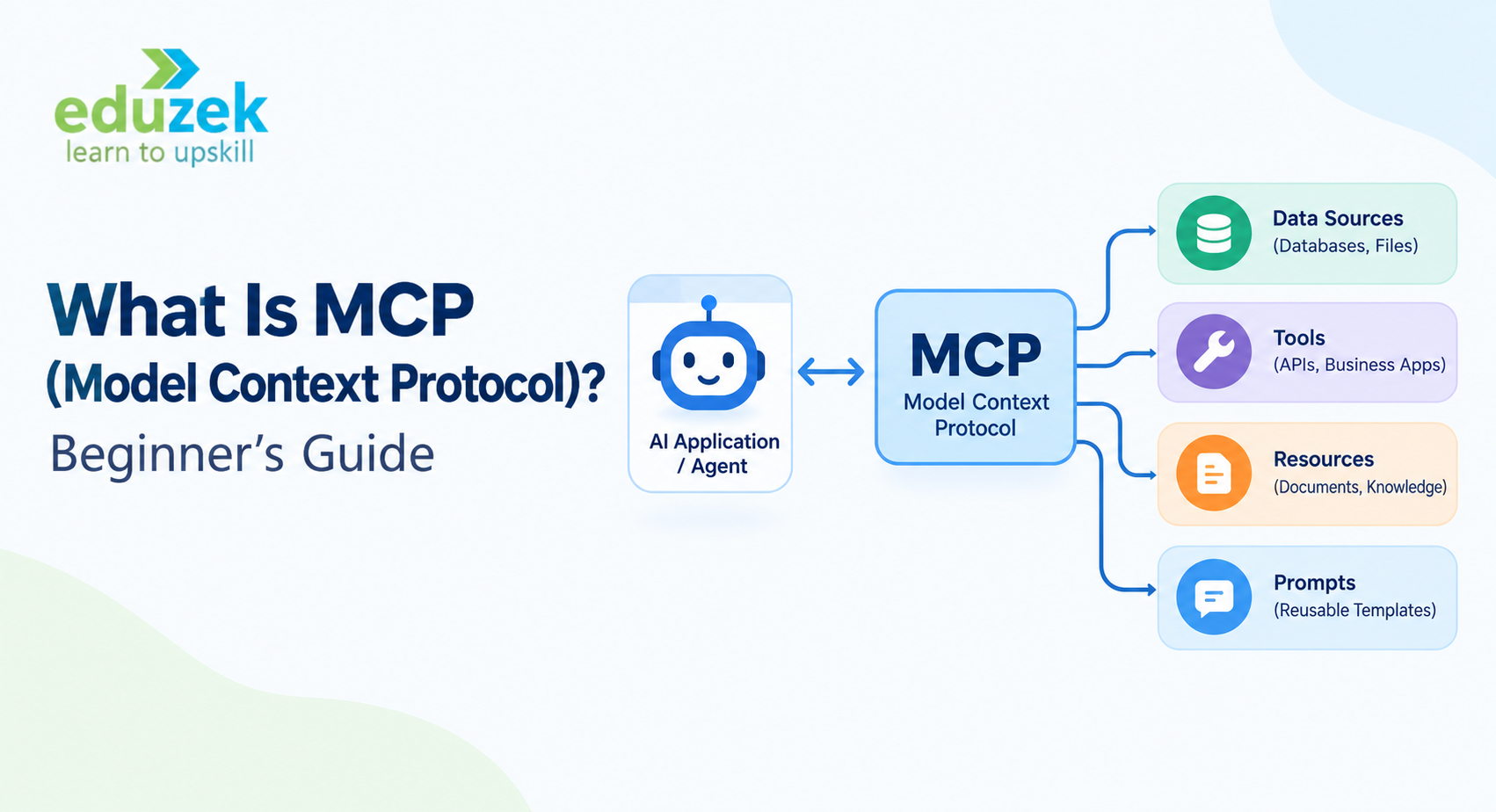
What Is MCP? Beginner's Guide to Model Context Protocol
October 5, 2026