


 Call us:
Agentic AI Course Syllabus: Skills, Tools, Frameworks and Practical Projects
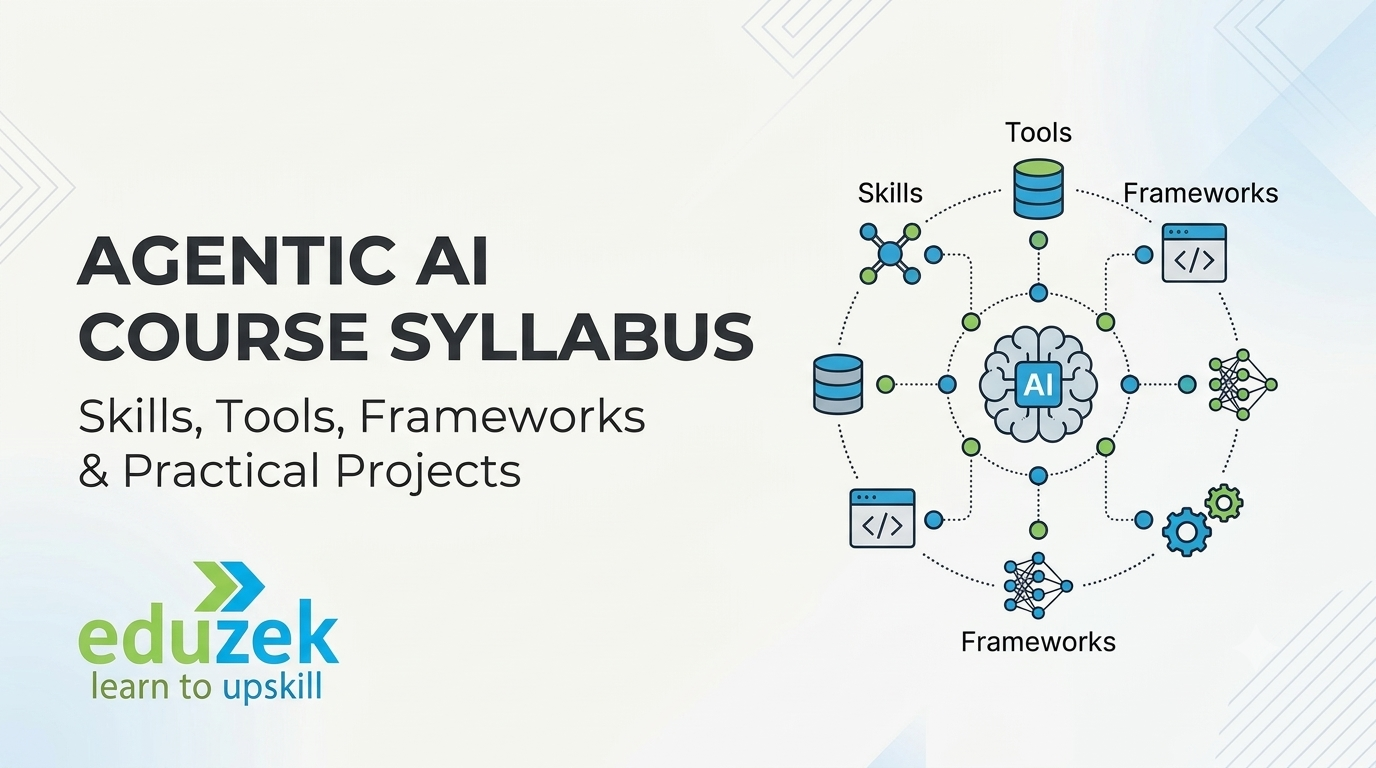
Agentic AI Course Syllabus: Skills, Tools, Frameworks and Practical Projects
Artificial Intelligence is moving beyond applications that simply respond to user questions or generate content. Modern AI systems are increasingly capable of planning tasks, accessing external tools, retrieving information, making decisions within defined boundaries and executing multi-step workflows.
This evolution has brought Agentic AI into focus.
Businesses are exploring AI agents for customer support, research, document processing, data analysis, workflow automation, software development and other business operations. Unlike traditional AI applications that primarily generate responses, agentic systems can use tools and information sources to work towards a defined objective.
However, developing an AI agent requires more than writing effective prompts. Developers need to understand Large Language Models (LLMs), Python, tool calling, agent workflows, memory, retrieval-augmented generation (RAG), orchestration frameworks, multi-agent collaboration, testing and deployment.
This makes the Agentic AI course syllabus an important consideration when choosing a training programme.
A comprehensive learning path should start with the fundamentals of programming and Generative AI before progressing towards AI agent development, frameworks, integrations and practical projects.
At Eduzek, the Generative AI and Agentic AI training programme follows a beginner-to-advanced learning approach. It covers Python, machine learning, NLP, LLMs, prompt engineering, RAG, vector databases, LangChain, LangGraph, LangSmith, AutoGen, CrewAI, MCP, model evaluation and deployment.
In this guide, we will explore the important topics that should be covered in an Agentic AI course, the tools and frameworks used for developing AI agents, practical projects learners can explore and the skills required to work with agentic applications.
1. What Is Agentic AI?
Agentic AI refers to AI systems designed to work towards specific objectives by planning tasks, using tools, retrieving information and executing multiple steps with varying levels of autonomy.
Traditional AI applications generally respond to a specific input. Agentic AI applications can go further by determining the steps required to complete a task and interacting with external systems to achieve the desired outcome.
For example, consider a traditional AI chatbot used by a customer support team.
A customer asks:
"Can you check the status of my order?"
A basic chatbot may generate a response based on information available in its knowledge base.
An AI agent, when appropriately connected and authorised, may be able to:
- Understand the customer's request.
- Identify the order number.
- Access an order management system.
- Retrieve the latest order information.
- Check the delivery status.
- Generate a response using the retrieved information.
- Escalate the request if the required information is unavailable.
The agent is not simply generating text. It is interacting with tools and information sources to complete a task.
Important Components of Agentic AI
An AI agent typically involves several components.
1. Large Language Model (LLM)
The LLM acts as the reasoning and language component, interpreting instructions and helping determine the next action.
2. Instructions and Goals
These define what the agent is expected to accomplish, including its responsibilities and limitations.
3. Tools
Tools allow an agent to interact with external systems, APIs, databases, search services and other applications.
4. Planning and Workflow Logic
These components determine how a complex task is divided into smaller steps and how the workflow progresses.
5. Memory and Context
Memory and context management help an agent retain relevant information during an interaction or workflow.
6. Knowledge Retrieval
Retrieval systems allow agents to access relevant documents, databases and other information sources.
7. Evaluation and Guardrails
Testing, validation and safety controls help ensure that agent actions and responses meet defined requirements.
Where Is Agentic AI Used?
Agentic AI can support several business and technical use cases.
- Customer support automation.
- Research and information gathering.
- Document analysis.
- Knowledge management.
- Software development assistance.
- Data analysis.
- Business process automation.
- IT service management.
- Sales and marketing workflows.
- Intelligent personal assistants.
Understanding these applications helps learners identify practical problems that can be addressed using AI agents.
2. How Are AI Agents Different from Traditional Generative AI Applications?
Generative AI and Agentic AI are closely related, but they serve different purposes.
Generative AI focuses on creating new content based on user inputs and model capabilities. This may include text, images, code, audio and other outputs.
Agentic AI builds on these capabilities by combining language models with tools, workflows, memory and decision-making processes to complete multi-step tasks.
Understanding the Difference
| ParameterTraditional Generative AI ApplicationAgentic AI Application | ||
| Primary purpose | Generate content or responses | Work towards a defined objective |
| Interaction | Usually prompt and response | Can involve multiple steps |
| Tool usage | May be limited or separately configured | Can use tools as part of an agent workflow |
| Planning | Usually handled by the user or application | Can plan and coordinate steps |
| Memory | Often limited to the supplied context | Can maintain or retrieve relevant state and memory |
| External systems | May have integrations | Can use integrations to perform tasks |
| Workflow | Often predefined | Can include conditional and adaptive execution |
| Example | Answering a question about a policy | Retrieving a policy, checking conditions and preparing an action |
Example: Generative AI vs Agentic AI in Research
Imagine that a user wants to research the latest developments in renewable energy.
A traditional Generative AI application may produce an answer based on the information available to its model or supplied context.
An Agentic AI research assistant may:
- Understand the research objective.
- Break the objective into smaller research questions.
- Search approved information sources.
- Retrieve relevant articles and documents.
- Compare information from different sources.
- Summarise important findings.
- Organise the results into a report.
- Provide references for verification.
This illustrates how agentic workflows can combine information retrieval, tool usage and content generation.
Why Should Developers Understand Both?
Agentic AI applications frequently depend on Generative AI models.
Therefore, developers need to understand:
- How LLMs work.
- How prompts influence outputs.
- How models process context.
- How APIs connect applications to models.
- How tools can be called.
- How information can be retrieved.
- How multi-step workflows can be orchestrated.
This is why a complete Agentic AI learning path should include Generative AI and LLM fundamentals.
3. Module 1: Python, Machine Learning and Deep Learning Fundamentals
Before building AI agents, learners should understand the programming and AI concepts used to develop intelligent applications.
Python is particularly important because many popular AI libraries and frameworks use it.
Eduzek's broader Generative AI and Agentic AI curriculum begins with Python, machine learning and deep learning foundations.
Python Programming Fundamentals
Python provides the programming foundation for building LLM applications and AI agents.
Important topics include:
- Python syntax and variables.
- Data types.
- Lists, tuples and dictionaries.
- Conditional statements.
- Loops.
- Functions.
- Modules and packages.
- Object-oriented programming fundamentals.
- Exception handling.
- File handling.
- Working with JSON.
- API communication.
Working with APIs and JSON
AI agents often communicate with external applications through APIs.
Developers should understand how to:
- Send HTTP requests.
- Handle API responses.
- Work with JSON data.
- Process structured information.
- Manage authentication.
- Handle API errors.
- Work with external services.
These skills are useful when connecting an AI agent to databases, search engines and business applications.
Machine Learning Fundamentals
Machine learning provides the foundation for understanding how systems learn patterns from data.
Important topics include:
Regression: Used to predict continuous numerical values.
Classification: Used to assign data to predefined categories.
Clustering: Used to group similar data points.
Learners should also understand training data, testing data, model performance and basic evaluation concepts.
Deep Learning Fundamentals
Deep learning uses neural networks to learn complex patterns from data.
Important concepts include:
- Neural networks.
- Layers and neurons.
- Activation functions.
- Training and inference.
- Model parameters.
- Basic optimisation concepts.
Why Are These Fundamentals Important?
Python helps you implement AI applications, while machine learning and deep learning provide the background needed to understand modern AI models.
You do not need to become an expert in every area before starting Agentic AI development. However, understanding the fundamentals makes it easier to work with frameworks, APIs and LLM-based applications.
Learning outcome: Develop the programming and AI foundation required to understand and build Generative AI and Agentic AI applications.
4. Module 2: NLP and Generative AI Fundamentals
Natural Language Processing (NLP) focuses on enabling computers to process and understand human language.
Since many AI agents interact with users through natural language, NLP and Generative AI concepts are important parts of an Agentic AI learning roadmap.
Understanding Natural Language Processing
Important NLP concepts include:
- Text preprocessing.
- Tokenisation.
- Text representation.
- Word and document embeddings.
- Semantic similarity.
- Language modelling.
- Transformer architecture.
Understanding Transformers
Transformers are an important neural network architecture behind modern language models.
Learners should understand the basic concepts of:
- Attention mechanisms.
- Self-attention.
- Token embeddings.
- Positional information.
- Encoder and decoder architectures.
- Transformer-based language models.
A conceptual understanding of transformers helps explain how LLMs process language and generate responses.
Introduction to Generative AI
Generative AI refers to AI systems capable of generating new content based on learned patterns and supplied instructions.
Common applications include:
- Text generation.
- Code generation.
- Image generation.
- Conversational applications.
- Document summarisation.
- Content creation.
The curriculum also introduces generative model concepts such as Generative Adversarial Networks (GANs) and Variational Autoencoders (VAEs).
Understanding Large Language Models
Large Language Models are trained on large amounts of data to understand and generate language.
Examples of commonly used LLM families include GPT, Claude, Gemini and open-source models.
Developers should understand:
- LLM architecture at a conceptual level.
- Tokens and context windows.
- Model inputs and outputs.
- Temperature and generation settings.
- Model APIs.
- Structured outputs.
- Limitations of LLMs.
- Hallucinations.
- Responsible AI considerations.
Introduction to Prompt Engineering
Prompt engineering involves designing instructions that help language models produce relevant and useful outputs.
Important techniques include:
Role-Based Prompting: Defining the role the model should perform.
Instruction-Based Prompting: Providing clear requirements and expected behaviour.
Few-Shot Prompting: Supplying examples to demonstrate the expected output.
Contextual Prompting: Providing relevant background information.
Structured Output Prompting: Asking the model to generate information in a defined format such as JSON.
Why Is Prompt Engineering Important for AI Agents?
An AI agent needs clear instructions to understand its objective and operate within defined boundaries.
For example, a customer support agent may need instructions to:
- Answer questions using approved documentation.
- Avoid inventing policy information.
- Request missing details.
- Use an order lookup tool when necessary.
- Escalate sensitive requests to a human representative.
Good prompting helps establish the agent's expected behaviour.
Learning outcome: Understand NLP, Generative AI, LLMs and prompt engineering concepts required to build AI-powered applications.
5. Module 3: LLM Integration, Tools and Function Calling
One of the most important concepts in Agentic AI development is the ability to connect language models with external tools.
An LLM can generate a response, but it cannot independently access a business database or perform an external action unless the application provides an appropriate integration.
Tool calling makes this possible.
What Is Tool Calling?
Tool calling allows an LLM-powered application to request the execution of a predefined function or external operation.
For example, a travel assistant may have access to tools such as:
- Search flights.
- Check hotel availability.
- Retrieve weather information.
- Calculate travel expenses.
- Search destination information.
When a user asks for a travel plan, the system can identify the tools required to complete the request.
Understanding Function Calling
Function calling allows developers to define functions that a model can select based on the user's request.
For example, a developer may define a function named get_order_status.
The function may accept an order ID and retrieve the corresponding order information from an authorised system.
A simplified conceptual example:
def get_order_status(order_id):
# Connect to an authorised order management system
# Retrieve order details
return {
"order_id": order_id,
"status": "Shipped"
}
The LLM can request the function when the user's question requires order information.
The application executes the function and returns its result to the model for response generation.
Important Tool Calling Concepts
- Function definitions.
- Tool descriptions.
- Parameter schemas.
- Structured inputs.
- Function execution.
- Tool responses.
- Error handling.
- Tool selection.
- API integrations.
- Authentication and permissions.
How Do AI Agents Use Tools?
Consider an AI agent designed to analyse sales information.
It may have access to:
- A database query tool.
- A sales calculation function.
- A chart generation tool.
- A report creation function.
When a user asks for a monthly sales analysis, the agent can determine which tools are required and coordinate their execution.
Important Considerations
Tool calling introduces additional risks because agents may interact with external systems.
Developers should understand:
- Input validation.
- API authentication.
- Permission management.
- Tool execution limits.
- Error handling.
- Human approval for sensitive actions.
- Logging and monitoring.
Learning outcome: Understand how LLMs interact with external functions, APIs and tools to perform tasks beyond text generation.
6. Module 4: Agent Planning, Reasoning and Workflow Execution
Planning and workflow execution are important concepts in Agentic AI.
An agent may receive a complex request that cannot be completed in a single step.
It needs a mechanism to identify the required tasks, determine their sequence and process the results.
Understanding Agent Planning
Suppose a user asks:
"Analyse three competitors and prepare a comparison report."
The agent may divide the request into smaller tasks:
- Identify the competitors.
- Search for relevant information.
- Retrieve available data.
- Organise the findings.
- Compare important parameters.
- Identify similarities and differences.
- Generate a structured report.
This process is an example of task decomposition.
Understanding Agent Reasoning
Reasoning refers to how an AI system processes information to determine appropriate next steps.
In an agentic workflow, the model may use the available context, instructions and tool results to determine what action should happen next.
Developers should understand:
- Task decomposition.
- Decision-making.
- Conditional execution.
- Goal-oriented workflows.
- Tool selection.
- Result evaluation.
- Retry mechanisms.
- Workflow termination.
Understanding Agent Loops
Many agent implementations follow a repeated process:
- Receive the task.
- Analyse the current information.
- Select an action.
- Execute the action.
- Observe the result.
- Determine the next step.
- Continue or complete the task.
This cycle allows an agent to work through multi-step problems.
Understanding Human-in-the-Loop Workflows
Not every action should be completed autonomously.
For example, an AI agent may prepare a purchase order, but the final approval should be provided by an authorised employee.
Human-in-the-loop mechanisms introduce checkpoints where users can:
- Review proposed actions.
- Approve operations.
- Reject incorrect decisions.
- Provide additional instructions.
- Take over complex tasks.
This is particularly important for financial, customer-facing and business-critical workflows.
Learning outcome: Understand how agents break down tasks, select actions and coordinate multi-step workflows with suitable human oversight.
7. Module 5: Memory and Context Management in AI Agents
Memory helps an AI agent maintain relevant information across multiple steps or interactions.
Without appropriate context management, an agent may lose track of previous information or repeatedly ask users for the same details.
What Is Memory in Agentic AI?
Memory refers to mechanisms that allow an agentic application to retain, retrieve or reuse relevant information.
For example, a customer support agent may need to remember:
- The customer's previous question.
- The order number.
- Information already retrieved.
- The current workflow stage.
- The actions already completed.
Types of Memory
1. Short-Term Memory
Short-term memory maintains information relevant to the current conversation or task.
For example, an agent may retain the user's requirements while completing a multi-step research task.
2. Long-Term Memory
Long-term memory stores selected information that may be useful across future interactions.
For example, an assistant may retrieve previously stored user preferences when permitted.
3. Conversation Memory
Conversation memory maintains relevant context from previous messages.
4. External Memory
External memory uses databases, files or vector stores to retain information beyond the immediate model context.
Understanding Context Management
Context management involves deciding what information should be available to the model at a particular stage of execution.
Important concepts include:
- Conversation history.
- Context windows.
- State management.
- Information summarisation.
- Memory retrieval.
- Context updates.
- Persistent storage.
- Context limitations.
Why Is Memory Important?
Memory can help agents maintain continuity, reduce repeated information requests and support longer workflows.
However, memory must be managed carefully.
Developers should consider:
- Data privacy.
- Information retention.
- Context relevance.
- Storage limitations.
- User permissions.
- Data deletion requirements.
Learning outcome: Understand how agents maintain task context and use memory mechanisms to support multi-step interactions.
8. Module 6: Retrieval-Augmented Generation (RAG) and Vector Databases
Retrieval-Augmented Generation is an important technique for developing AI applications that need access to external knowledge.
LLMs may not have access to an organisation's latest documents, internal policies or private business information.
RAG addresses this challenge by retrieving relevant information from external sources and providing it to the model as context.
What Is RAG?
RAG combines information retrieval with language model generation.
Instead of relying only on information learned during model training, an application retrieves relevant documents or data before generating a response.
For example, an HR assistant may need to answer questions based on company leave policies.
A RAG-based application can:
- Accept a question from an employee.
- Search the relevant HR documents.
- Retrieve matching information.
- Supply the retrieved content to the LLM.
- Generate a response based on the available information.
Understanding the RAG Architecture
A typical RAG pipeline includes the following steps.
Step 1: Document Ingestion
Documents are collected from supported sources such as PDFs, Word files, websites and databases.
Step 2: Document Processing
The information is extracted and prepared for retrieval.
Step 3: Text Chunking
Large documents are divided into smaller sections.
Step 4: Embedding Generation
Text sections are converted into numerical vector representations.
Step 5: Vector Storage
Embeddings and associated metadata are stored in a vector database or another retrieval system.
Step 6: Query Processing
A user submits a question.
Step 7: Information Retrieval
The system searches for relevant document sections.
Step 8: Response Generation
The retrieved information is provided to the LLM to generate a context-grounded answer.
Understanding Embeddings
Embeddings represent text, images or other information as numerical vectors.
They help systems identify semantic similarities between different pieces of information.
For example, the questions:
- "How many days of leave can employees take?"
- "What is the annual leave entitlement?"
may have similar meanings even though they use different words.
Embeddings support semantic retrieval by identifying related information.
Understanding Vector Databases
Vector databases store and retrieve vector representations.
Technologies covered in Eduzek's broader curriculum include:
- Pinecone.
- FAISS.
- Milvus.
Learners should understand concepts such as:
- Vector storage.
- Similarity search.
- Embedding retrieval.
- Metadata filtering.
- Indexing.
- Retrieval quality.
How Does RAG Support Agentic AI?
An AI agent can use RAG as a knowledge retrieval tool.
For example, a customer support agent may retrieve product documentation, identify the relevant policy and use that information to answer a customer.
An agent can also combine retrieval with other tools to perform more complex tasks.
Understanding Agentic RAG
Agentic RAG extends retrieval workflows by introducing agent-driven decisions.
For example, an agent may:
- Analyse the user's question.
- Decide whether additional information is required.
- Select an appropriate retrieval source.
- Retrieve relevant documents.
- Evaluate whether the information is sufficient.
- Refine the query if necessary.
- Generate a final answer.
Learning outcome: Understand how to build retrieval-based AI applications using embeddings, vector databases and LLMs, and how retrieval can become part of an agentic workflow.
9. Module 7: LangChain and LangGraph Frameworks
Frameworks help developers organise the components required to build AI applications.
LangChain and LangGraph are important technologies in modern LLM and Agentic AI development.
Eduzek's curriculum includes practical learning with LangChain, LangGraph and LangSmith.
What Is LangChain?
LangChain is a framework that provides components and integrations for developing applications powered by language models.
It helps developers connect models with prompts, tools, retrieval systems and other application components.
Important LangChain Concepts
1. Model Integration
Connect applications with supported language models.
2. Prompt Templates
Create reusable prompts with dynamic input values.
3. Chains
Combine multiple operations into an organised sequence.
4. Tool Integration
Connect LLM applications with external functions and services.
5. Retrieval Integration
Connect applications with document retrieval and vector databases.
6. Agents
Build applications where an LLM can select tools and perform actions based on a task.
7. Memory and Context
Manage relevant information across interactions and workflows.
What Is LangGraph?
LangGraph is a framework for building stateful, multi-step AI workflows using graph-based orchestration.
It is particularly useful when developers need greater control over workflow execution.
Important LangGraph Concepts
- Nodes.
- Edges.
- Graph structures.
- State management.
- Conditional routing.
- Tool execution.
- Workflow checkpoints.
- Persistence.
- Human-in-the-loop interactions.
- Error recovery.
LangChain vs LangGraph
| FeatureLangChainLangGraph | ||
| Main purpose | Building LLM applications and agent components | Orchestrating stateful AI workflows |
| Structure | Components and integrations | Graph-based workflow |
| Workflow management | Supports sequential and agent workflows | Supports complex conditional execution |
| State handling | Depends on application architecture | Explicit state-based orchestration |
| Common use cases | LLM applications, RAG and tool integration | Multi-step agents and controlled workflows |
What Is LangSmith?
LangSmith supports development, tracing, evaluation and monitoring of LLM applications.
It helps developers understand how an application behaves and investigate issues during execution.
Important areas include:
- Tracing.
- Execution inspection.
- Testing.
- Evaluation.
- Monitoring.
- Debugging.
Learning outcome: Understand how LangChain and LangGraph support LLM application development and agent orchestration, and how LangSmith can support application evaluation and debugging.
10. Module 8: Multi-Agent Systems and Agent Collaboration
A single AI agent may be sufficient for a simple task.
However, complex applications may benefit from multiple specialised agents working together.
This approach is known as a multi-agent system.
What Is a Multi-Agent System?
A multi-agent system consists of multiple AI agents that collaborate to achieve a shared objective or complete different parts of a workflow.
Each agent may have a specialised responsibility.
For example, a content research workflow may use:
Research Agent: Searches approved sources and gathers information.
Analysis Agent: Organises the findings and identifies important insights.
Writing Agent: Creates the first draft.
Review Agent: Checks the content for completeness and consistency.
An orchestration mechanism coordinates the agents and manages the overall workflow.
Important Multi-Agent Concepts
- Agent roles.
- Task delegation.
- Agent communication.
- Shared state.
- Workflow orchestration.
- Collaboration.
- Result aggregation.
- Conflict resolution.
- Execution monitoring.
Understanding CrewAI
CrewAI is a framework for creating collaborative AI agent systems.
It allows developers to define specialised agents, assign tasks and organise their interactions.
Important concepts include:
- Agents.
- Roles.
- Goals.
- Tasks.
- Tools.
- Crews.
- Process management.
Understanding AutoGen
AutoGen is a framework for building applications involving AI agents and their interactions.
It supports patterns for agent collaboration and coordinated execution.
The exact APIs and framework architecture can evolve, so learners should practise with current framework documentation and supported versions.
When Should You Use Multi-Agent Systems?
Multi-agent architecture may be useful when:
- A task involves multiple specialised responsibilities.
- Different agents need different tools.
- Work can be divided into separate stages.
- Different outputs need independent review.
- A workflow requires coordination between specialised components.
However, multiple agents are not always necessary.
For simple tasks, a single well-designed agent or a deterministic workflow may be more efficient and easier to maintain.
Learning outcome: Understand how specialised agents can collaborate and how frameworks such as CrewAI and AutoGen support multi-agent application development.
11. Module 9: Model Context Protocol (MCP)
As AI agents become more connected to external systems, developers need ways to standardise how applications access tools and information.
Model Context Protocol, commonly known as MCP, addresses this requirement.
What Is MCP?
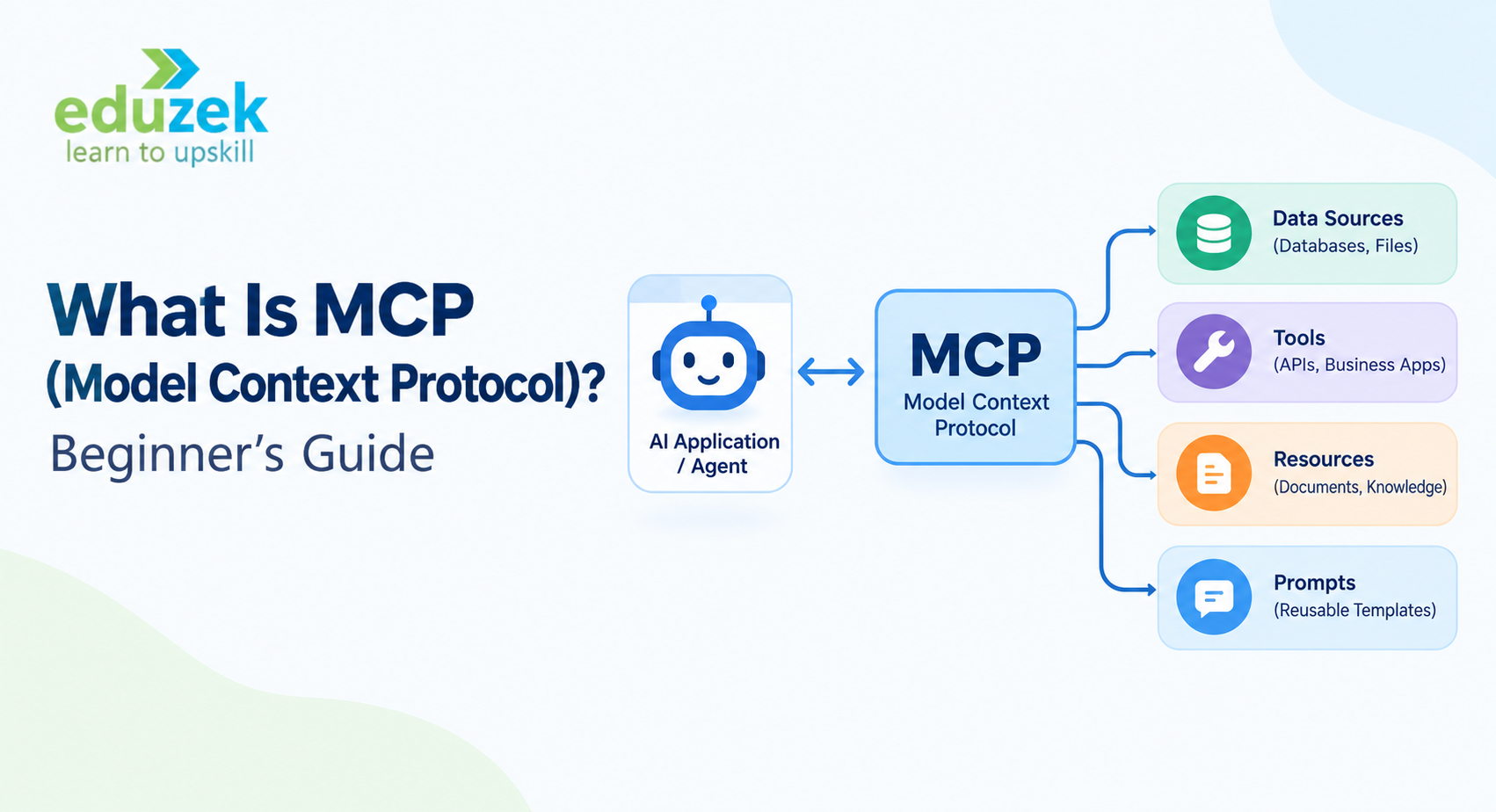
MCP is an open protocol designed to connect AI applications with external tools, resources and context sources through a standardised interface.
It helps AI applications communicate with compatible services without requiring every integration to be designed from scratch.
Understanding MCP Architecture
An MCP-based setup generally involves three important components.
1. MCP Host
The application that provides the overall AI experience and manages connections to MCP servers.
2. MCP Client
The component responsible for communicating with an MCP server.
3. MCP Server
The service that exposes tools, resources or prompts to compatible clients.
Important MCP Concepts
Tools: Allow an AI application to invoke supported operations.
Resources: Provide access to contextual information.
Prompts: Offer reusable prompt templates or interaction patterns.
Example of MCP in an AI Assistant
Imagine an AI assistant that needs to access project management information.
An MCP server may expose approved tools for:
- Retrieving project information.
- Listing assigned tasks.
- Checking task status.
- Accessing project documentation.
The assistant can use these capabilities through an MCP-compatible connection.
MCP Security Considerations
Connecting an AI application to external tools requires careful access management.
Developers should understand:
- Authentication.
- Authorisation.
- Tool permissions.
- Input validation.
- Data access boundaries.
- Server trust.
- Logging.
- Human approval for sensitive operations.
MCP is an important area to explore because it provides a standardised way to connect AI applications with external capabilities.
Learning outcome: Understand MCP architecture and how AI applications can access compatible tools and resources through MCP servers.
12. Module 10: Agent Evaluation, Testing and Reliability
Building an AI agent is only one part of the development process.
You also need to verify whether it performs tasks correctly, uses tools appropriately and handles unexpected situations.
An agent that produces convincing responses but performs incorrect actions cannot be considered reliable.
Why Is Agent Evaluation Important?
AI agents can make mistakes while:
- Interpreting instructions.
- Selecting tools.
- Retrieving information.
- Processing results.
- Executing workflows.
- Generating final responses.
Evaluation helps identify these issues before an application is used in important business processes.
Important Agent Testing Areas
1. Response Quality
Check whether the agent generates relevant, accurate and understandable responses.
2. Tool Selection
Verify whether the agent selects the appropriate tools for a task.
3. Tool Execution
Check whether tools receive valid inputs and return expected results.
4. Workflow Completion
Verify whether the agent completes the requested steps correctly.
5. Retrieval Quality
Evaluate whether the RAG system retrieves relevant information.
6. Error Handling
Check how the application responds when APIs fail or information is unavailable.
7. Security
Verify whether the agent respects access permissions and data boundaries.
LLM Evaluation
Eduzek's broader curriculum includes LLM evaluation metrics and responsible AI practices.
Important evaluation considerations include:
- Response relevance.
- Factual accuracy.
- Context relevance.
- Retrieval quality.
- Output consistency.
- Latency.
- Token usage.
- Cost.
- Safety.
Observability and Monitoring
Observability helps developers understand what happens during application execution.
Useful information may include:
- Agent execution traces.
- Tool calls.
- API responses.
- Errors.
- Execution time.
- Model usage.
- Workflow outcomes.
Tools such as LangSmith and LangFuse can support monitoring and observability of LLM applications.
Responsible AI and Guardrails
AI agents should operate within clearly defined boundaries.
Developers should understand:
- Input validation.
- Output validation.
- Sensitive information handling.
- Permission checks.
- Prompt injection risks.
- Tool access restrictions.
- Human approval.
- Audit logging.
Why Reliability Matters
An agent used for research may be allowed to retrieve and summarise information automatically.
An agent that initiates payments or modifies important business records requires much stronger validation and approval mechanisms.
The level of autonomy should match the risk associated with the task.
Learning outcome: Understand how to evaluate, test, monitor and improve AI agents before deploying them into real-world workflows.
13. Module 11: Fine-Tuning, Advanced LLMs and Multimodal AI
A comprehensive Generative AI and Agentic AI programme may also introduce advanced concepts beyond basic agent development.
Eduzek's broader curriculum includes fine-tuning, model optimisation and multimodal AI.
These concepts help learners understand how LLM applications can be adapted and extended for different requirements.
Understanding LLM Fine-Tuning
Fine-tuning involves adapting a pretrained model using additional training data for a particular task or behaviour.
It may be useful when an application requires more specialised model behaviour.
Important topics include:
- Fine-tuning fundamentals.
- Training data preparation.
- Model adaptation.
- Evaluation.
- Training considerations.
LoRA and QLoRA
LoRA and QLoRA are techniques used to make model fine-tuning more resource-efficient.
LoRA: Uses low-rank adaptation to update a smaller set of trainable parameters rather than all model parameters.
QLoRA: Combines quantisation with LoRA to reduce memory requirements during fine-tuning.
Quantization
Quantisation reduces the numerical precision used to represent model parameters.
It can help reduce memory requirements and support more efficient model deployment, depending on the model and hardware.
Multimodal AI
Multimodal AI systems can process or generate different types of information.
These may include:
- Text.
- Images.
- Audio.
- Video.
Eduzek's broader curriculum introduces multimodal LLMs and diffusion models for image and video generation.
Reinforcement Learning Fundamentals
Reinforcement learning studies how systems learn through interactions with an environment and feedback based on actions.
Understanding its fundamentals provides additional context for advanced AI systems and optimisation techniques.
Learning outcome: Develop awareness of advanced model adaptation, optimisation and multimodal AI concepts that complement Agentic AI development.
14. Module 12: Deployment, APIs and Production Readiness
Developing an AI agent in a local environment is different from making it available to real users.
A production-oriented application needs an interface, API integration, deployment infrastructure, monitoring and suitable security controls.
Understanding AI Application Deployment
Deployment involves making an AI application accessible through an appropriate environment.
Important concepts include:
- Application architecture.
- Model integration.
- API endpoints.
- Backend services.
- Frontend interfaces.
- Authentication.
- Environment configuration.
- Error handling.
Working with FastAPI
FastAPI is a Python framework for developing APIs.
It can be used to expose AI application functionality through HTTP endpoints.
For example, an AI agent can be made accessible through an API so that another application can submit a task and receive the result.
Streamlit and Gradio
Streamlit and Gradio help developers create interfaces for machine learning and AI applications.
They can be used to build demonstrations and interactive applications.
Understanding Docker
Docker helps package applications and their dependencies into containers.
It supports consistent application execution across different environments.
Monitoring and Observability
After deployment, developers should monitor:
- Application performance.
- API availability.
- Error rates.
- Response time.
- Model usage.
- Resource consumption.
- Agent execution.
- User interactions.
Understanding MLOps Basics
MLOps introduces practices for managing AI and machine learning applications across their lifecycle.
The broader Eduzek curriculum includes deployment strategies, Docker and observability concepts.
Learning outcome: Understand the fundamentals of making AI applications accessible, maintainable and monitorable beyond the development environment.
15. Practical Agentic AI Projects You Should Build
Theory alone is not enough to understand Agentic AI development.
Practical projects help learners connect LLMs, tools, retrieval, memory and orchestration into working applications.
Eduzek's published Agentic AI course page outlines several guided project ideas. The broader Generative AI and Agentic AI curriculum also includes an end-to-end AI agent capstone project.
Here are important projects to understand.
Project 1: Research Assistant Agent
Objective: Build an AI agent that can research a topic and prepare a structured report.
Possible workflow:
- Accept a research question.
- Break it into smaller tasks.
- Search approved information sources.
- Retrieve relevant information.
- Summarise important findings.
- Organise the results.
- Generate a structured report.
- Include source references for verification.
Skills involved:
- LLM integration.
- Prompt engineering.
- Tool calling.
- Search integration.
- Task planning.
- Report generation.
Project 2: RAG-Powered Document Assistant
Objective: Develop an AI assistant that answers questions using uploaded documents.
Possible workflow:
- Upload documents.
- Extract document text.
- Divide documents into chunks.
- Generate embeddings.
- Store vectors.
- Retrieve relevant information.
- Generate answers using retrieved context.
Skills involved:
- RAG.
- Embeddings.
- Vector databases.
- Document processing.
- LLM integration.
- Retrieval evaluation.
Project 3: Customer Support Agent
Objective: Create an AI agent that answers customer questions using an approved knowledge base.
Possible workflow:
- Receive a customer question.
- Identify the intent.
- Retrieve relevant support documentation.
- Use approved tools when additional information is needed.
- Generate a response.
- Escalate cases requiring human intervention.
Skills involved:
- Prompt engineering.
- RAG.
- Tool calling.
- API integration.
- Memory.
- Human-in-the-loop workflows.
Project 4: Multi-Agent Content Workflow
Objective: Develop a workflow in which specialised agents collaborate to produce content.
Possible agent responsibilities:
- Research agent.
- Content planning agent.
- Writing agent.
- Review agent.
The workflow coordinates their activities and produces a final content draft.
Skills involved:
- Multi-agent systems.
- Task delegation.
- Agent orchestration.
- LangGraph.
- CrewAI.
- Output evaluation.
Project 5: LangGraph Task Automation Agent
Objective: Develop a stateful AI workflow that can perform a multi-step task.
Possible workflow:
- Receive a task.
- Identify the required operations.
- Execute an appropriate tool.
- Evaluate the result.
- Route execution based on conditions.
- Retry or recover from errors.
- Complete the workflow.
Skills involved:
- LangGraph.
- State management.
- Conditional routing.
- Tool execution.
- Workflow checkpoints.
- Error recovery.
Project 6: MCP-Connected AI Assistant
Objective: Build an AI assistant that accesses compatible external tools or resources through an MCP server.
Possible workflow:
- Connect to an MCP server.
- Discover available tools and resources.
- Select an appropriate capability.
- Validate the requested operation.
- Execute the approved action.
- Process the returned information.
Skills involved:
- MCP architecture.
- MCP clients and servers.
- Tool integration.
- API concepts.
- Permissions.
- Input validation.
Project 7: Agentic RAG Capstone
Objective: Combine information retrieval, agent planning and tool usage into a knowledge-based AI application.
Possible workflow:
- Understand the user's question.
- Determine whether external information is required.
- Select the relevant retrieval source.
- Retrieve documents.
- Evaluate information quality.
- Use additional tools when needed.
- Generate a grounded response.
- Evaluate the final output.
Skills involved:
- RAG.
- LangChain.
- LangGraph.
- Vector databases.
- Tool calling.
- Agent evaluation.
These projects provide a useful way to understand how different technologies contribute to agentic application development. The exact project selection, implementation depth and hands-on exercises may vary by training batch.
16. What Skills Will You Gain After Completing an Agentic AI Course?
A well-structured Agentic AI training programme should help learners develop both conceptual understanding and practical technical skills.
The exact proficiency achieved depends on prior experience, practice and project complexity.
Technical Skills
Python Programming
Understand the programming concepts used to build AI applications.
LLM Integration
Learn how to connect language models with applications through APIs.
Prompt Engineering
Design instructions and prompts for different AI tasks.
Tool Calling
Connect AI agents with external functions and services.
RAG Development
Build retrieval-based applications using embeddings and vector databases.
LangChain and LangGraph
Understand frameworks used for LLM application development and workflow orchestration.
Multi-Agent Development
Explore how specialised agents can collaborate.
MCP Integration
Understand how AI applications connect with compatible tools and resources.
Evaluation and Testing
Learn how to assess application performance and reliability.
Deployment Fundamentals
Understand APIs, application serving, Docker and monitoring.
Problem-Solving Skills
In addition to technical knowledge, Agentic AI development requires the ability to:
- Break complex problems into smaller tasks.
- Identify suitable automation opportunities.
- Select appropriate AI models and tools.
- Design workflows.
- Validate information.
- Handle unexpected results.
- Evaluate application performance.
Project Development Skills
Practical work helps you understand how to combine different technologies into a complete application.
A project portfolio may demonstrate your knowledge of RAG, tool calling, multi-agent workflows, MCP integration and deployment.
17. Who Should Learn Agentic AI?
Agentic AI is relevant to professionals who want to understand how intelligent applications can interact with external systems and automate multi-step tasks.
1. Software Developers
Developers can expand their knowledge of LLM applications, API integration, tool calling and AI agent frameworks.
2. AI and Machine Learning Professionals
AI and ML professionals can explore agent orchestration, retrieval systems and intelligent workflow development.
3. Data Scientists
Data scientists can explore research assistants, data analysis agents and knowledge retrieval applications.
4. Data Analysts
Data analysts can learn how AI agents may retrieve information, analyse datasets and support reporting workflows.
5. Working Professionals
Professionals interested in business automation and AI-powered applications can understand how agentic workflows can support operational activities.
6. Students and Fresh Graduates
Students interested in AI engineering and software development can build foundational knowledge through Python, machine learning, Generative AI and Agentic AI.
7. Tech Entrepreneurs
Entrepreneurs and product teams can explore AI agent use cases and understand how intelligent applications can address business requirements.
8. IT Professionals
IT professionals can learn about AI integration, application development, workflow automation and deployment.
What Are the Prerequisites?
Basic programming familiarity is helpful for Agentic AI development.
However, beginners do not necessarily need prior expertise in Generative AI or advanced machine learning.
A suitable learning programme should introduce the necessary foundations.
Before enrolling, consider your comfort with:
- Basic programming concepts.
- Python fundamentals.
- Working with data.
- APIs and JSON.
- Logical problem-solving.
Eduzek's programme covers Python and machine learning fundamentals as part of its wider curriculum, making it suitable for beginners interested in progressing towards advanced AI application development.
18. How to Evaluate an Agentic AI Course Before Enrolling
The quality of an Agentic AI course depends on more than the number of frameworks mentioned in its syllabus.
You should evaluate whether the programme teaches the concepts needed to build, test and deploy practical AI agents.
Here are important factors to consider.
1. Check the LLM Fundamentals
The syllabus should introduce Large Language Models, transformers, tokens, embeddings and model APIs.
Without these fundamentals, it may be difficult to understand how AI agents work.
2. Look for Python Training
Python is widely used for AI development.
If you are a beginner, check whether the programme covers Python fundamentals or expects you to know them already.
3. Verify Prompt Engineering Coverage
The course should explain how to design instructions, provide context and work with structured outputs.
4. Check Tool Calling and Function Integration
Tool usage is a central part of Agentic AI.
Look for practical coverage of functions, APIs, tool selection and execution.
5. Evaluate Planning and Memory Concepts
The syllabus should explain how agents handle multi-step tasks, maintain context and manage workflow state.
6. Check RAG and Vector Database Coverage
A useful programme should introduce document processing, embeddings, retrieval and vector databases.
7. Verify Framework Coverage
Look for frameworks relevant to the course objectives, such as:
- LangChain.
- LangGraph.
- LangSmith.
- CrewAI.
- AutoGen.
- MCP.
A good course should explain how and when these technologies are used rather than simply listing their names.
8. Check Multi-Agent Systems
The programme should explain how multiple agents collaborate, delegate tasks and coordinate workflows.
9. Evaluate Testing and Reliability
Check whether the course introduces LLM evaluation, tracing, monitoring, error handling and responsible AI practices.
10. Look for Deployment Topics
A comprehensive programme should introduce how AI applications can be served and deployed using technologies such as FastAPI, Streamlit, Gradio and Docker.
11. Verify Practical Projects
Projects should allow you to apply multiple concepts together.
Look for RAG applications, research agents, customer support assistants, multi-agent workflows and an end-to-end capstone.
12. Understand the Training Format
Check whether the programme offers:
- Live instructor-led sessions.
- Trainer guidance.
- Doubt-clearing support.
- Practical exercises.
- Project assistance.
- Recorded sessions, where available.
13. Check Course Duration
Understand the total training hours, session schedule and expected time commitment.
14. Clarify Certification
Ask whether the programme includes a course completion certificate and whether any external certification examination is part of the offering.
Evaluating these factors can help you choose a course that provides a balanced combination of theory, tools and practical development.
19. How Does Eduzek's Agentic AI Course Cover These Learning Areas?
Eduzek offers a Generative AI and Agentic AI training programme designed to take learners from programming and AI foundations to advanced AI application development.
The published curriculum covers several important areas required for understanding modern AI systems.
A. Python, Machine Learning and Deep Learning Foundations
The programme begins with:
- Python programming fundamentals.
- Machine learning basics.
- Regression.
- Classification.
- Clustering.
- Deep learning.
- Neural network fundamentals.
These concepts provide the technical foundation for AI development.
B. NLP and Generative AI Foundations
Learners explore:
- NLP fundamentals.
- Tokenisation.
- Embeddings.
- Transformers.
- Generative AI.
- GANs.
- Variational Autoencoders.
- Large Language Models.
- Prompt engineering.
C. LLMs, RAG and Vector Databases
This section covers:
- RAG concepts and pipelines.
- Document processing.
- Embeddings.
- Vector databases.
- Pinecone.
- Milvus.
- FAISS.
- LLM evaluation.
- Responsible AI guardrails.
D. LangChain, LangGraph and Agentic AI
The curriculum includes:
- LangChain architecture.
- Agents and memory.
- LangGraph workflows.
- LangSmith.
- Introduction to AI agents.
- Agentic AI concepts.
- Multi-agent workflows.
E. Building and Evaluating AI Agents
Learners explore:
- Hands-on agent development.
- LangChain and LangGraph.
- Agentic RAG.
- Knowledge graphs.
- Open-source LLMs.
- Hugging Face.
- Model evaluation.
F. Fine-Tuning, Multimodal AI and Advanced Topics
The wider Generative AI curriculum also introduces:
- LoRA.
- QLoRA.
- Quantisation.
- Multimodal LLMs.
- Diffusion models.
- Image and video generation.
- Reinforcement learning fundamentals.
G. Deployment, Frameworks and Capstone
The final learning areas include:
- FastAPI.
- Streamlit.
- Gradio.
- Deployment strategies.
- Docker.
- Observability.
- LangSmith.
- LangFuse.
- AutoGen.
- CrewAI.
- MCP.
- End-to-end AI agent capstone.
This structure connects programming foundations, Generative AI, retrieval, agent development and deployment.
For learners who want to explore the detailed curriculum, course duration, prerequisites and available training formats, visit Eduzek's Agentic AI Course and Training in India.
20. Why Choose Eduzek for Agentic AI Training?
Choosing a suitable training provider is an important step when learning a developing technology such as Agentic AI.
The learning experience should combine structured concepts, trainer guidance and practical exposure.
Here are some features of Eduzek's Generative AI and Agentic AI training programme.
Structured Beginner-to-Advanced Curriculum
The programme covers Python and machine learning foundations before moving towards LLMs, RAG, agent frameworks and deployment.
Industry-Expert Trainers
Eduzek's programme is delivered by industry-expert and certified trainers who guide learners through the course concepts.
Hands-On Learning
The training is designed around practical AI application development, including RAG, agent workflows and an end-to-end AI agent capstone.
Exposure to Relevant Frameworks
Learners explore technologies such as LangChain, LangGraph, LangSmith, AutoGen, CrewAI and MCP.
Flexible Training Formats
Eduzek offers:
- Group Batch.
- 1:1 Training.
- Corporate Training.
Public batches are conducted online. Offline delivery for 1:1 and corporate training can be arranged based on request.
Training Duration
The published course duration is approximately 100–130 hours, depending on the batch and training schedule.
Course Completion Certificate
A course completion certificate is included in the programme.
Beginner-Friendly Learning Path
The course covers Python and machine learning fundamentals, making it possible for learners without prior Generative AI experience to begin with the foundational modules.
To understand the complete course structure and enquire about upcoming batches, visit Eduzek's Agentic AI Course Training page.
Conclusion: Choose an Agentic AI Course That Combines Fundamentals, Frameworks and Projects
Agentic AI is changing how developers approach intelligent application development.
Instead of building applications that only generate responses, developers can now create systems that retrieve information, use tools, coordinate workflows and work towards defined objectives.
However, building reliable AI agents requires a combination of skills.
You need to understand Python, machine learning, NLP, LLMs, prompt engineering, tool calling, memory, RAG, vector databases, agent orchestration, multi-agent frameworks and deployment.
A structured Agentic AI course syllabus should introduce these concepts progressively and provide practical opportunities to apply them.
When comparing training programmes, look beyond the list of frameworks. Evaluate the depth of the curriculum, the practical projects, trainer support, evaluation methods and deployment topics.
Eduzek's Generative AI and Agentic AI training brings together these learning areas through a beginner-to-advanced curriculum covering Python, LLMs, RAG, LangChain, LangGraph, AutoGen, CrewAI, MCP and practical AI application development.
Whether you are a software developer, student, data professional or working professional, learning these technologies can help you build a foundation for working with modern AI applications.
Explore the Agentic AI Course Training at Eduzek to review the published syllabus, understand the available training formats and take the next step in your AI learning journey.
Frequently Asked Questions (FAQs)
1. What is an Agentic AI course syllabus?
An Agentic AI course syllabus is a structured outline of the topics covered while learning to develop AI agents. It can include Python, LLMs, prompt engineering, tool calling, planning, memory, RAG, vector databases, LangChain, LangGraph, multi-agent systems, MCP, evaluation and deployment.
2. What are the main topics covered in Agentic AI training?
A comprehensive Agentic AI training programme may cover:
- Python and AI fundamentals.
- Natural Language Processing.
- Generative AI and LLMs.
- Prompt engineering.
- Tool calling and function integration.
- Agent planning and reasoning.
- Memory and context management.
- Retrieval-Augmented Generation.
- Vector databases.
- LangChain and LangGraph.
- Multi-agent systems.
- CrewAI and AutoGen.
- Model Context Protocol.
- Agent evaluation.
- Deployment and monitoring.
The exact topics depend on the training provider and programme.
3. What is the difference between Generative AI and Agentic AI?
Generative AI focuses on generating content such as text, images, audio and code. Agentic AI uses AI models along with tools, memory and workflow orchestration to complete multi-step tasks.
Agentic AI applications commonly use Generative AI models as part of their architecture.
4. Do I need Python to learn Agentic AI?
Basic Python programming knowledge is recommended for developing AI agents.
However, beginners can start with a programme that covers Python fundamentals before introducing LLM frameworks and agent development.
5. Is Agentic AI suitable for beginners?
Yes. Beginners can learn Agentic AI by following a structured learning path that starts with Python, machine learning and Generative AI fundamentals.
You do not necessarily need prior experience in advanced AI development, but programming familiarity is helpful.
6. What is LangChain used for in Agentic AI?
LangChain is used to develop LLM-powered applications by connecting language models with prompts, tools, retrieval systems and other components.
It provides building blocks for developing applications and agent workflows.
7. What is LangGraph used for?
LangGraph is used to build stateful and multi-step AI workflows using graph-based orchestration. It supports conditional routing, state management, checkpoints and controlled execution.
8. What is the difference between LangChain and LangGraph?
LangChain provides components and integrations for building LLM applications, while LangGraph focuses on managing stateful workflows and coordinating complex agent execution.
Both technologies can be used together.
9. What is RAG in Agentic AI?
Retrieval-Augmented Generation allows AI applications to retrieve relevant information from external knowledge sources before generating responses.
AI agents can use RAG to access documents, databases and organisational knowledge when completing tasks.
10. Which vector databases are used in Agentic AI?
Common vector database technologies include Pinecone, FAISS and Milvus.
They support vector storage and similarity-based retrieval for applications such as RAG.
11. What are multi-agent systems?
Multi-agent systems involve multiple specialised AI agents collaborating to complete a shared objective or different parts of a workflow.
For example, separate research, analysis and writing agents may work together to prepare a report.
12. What is CrewAI?
CrewAI is a framework for building collaborative AI agent systems. It allows developers to define agents, assign responsibilities and coordinate tasks.
13. What is AutoGen?
AutoGen is a framework for developing applications involving AI agents and their interactions. It supports different approaches to agent collaboration and coordinated execution.
14. What is Model Context Protocol (MCP)?
MCP is an open protocol that standardises how AI applications connect with external tools and context sources through compatible clients and servers.
It can help developers build applications that interact with external capabilities through a common interface.
15. Does an Agentic AI course include practical projects?
A project-based Agentic AI course should include hands-on development opportunities.
Eduzek's published course page outlines projects such as a research assistant, RAG-powered document assistant, customer support agent, multi-agent content workflow, LangGraph task automation agent, MCP-connected assistant and Agentic RAG capstone.
16. What tools and frameworks are covered in Eduzek's Agentic AI training?
Eduzek's published Generative AI and Agentic AI curriculum includes Python, LangChain, LangGraph, LangSmith, Pinecone, FAISS, Milvus, Hugging Face, AutoGen, CrewAI, MCP, FastAPI, Streamlit, Gradio and Docker.
17. Does Eduzek's Agentic AI course include RAG?
Yes. The broader course curriculum covers RAG concepts and pipelines, embeddings, document processing, vector databases, Agentic RAG and related application development concepts.
18. Does the course cover AI agent deployment?
Yes. The published curriculum includes model serving with FastAPI, Streamlit and Gradio, deployment strategies, Docker and observability.
19. How long is Eduzek's Agentic AI course?
Eduzek lists an indicative course duration of 100–130 hours for its Generative AI and Agentic AI training. The exact schedule and project structure may vary by batch.
20. What are the prerequisites for Eduzek's Agentic AI training?
Basic programming familiarity is helpful. Python fundamentals and machine learning foundations are covered in the programme, so prior expertise in Generative AI or Agentic AI is not required.
21. Who can join Eduzek's Agentic AI course?
The programme is suitable for software developers, AI and machine learning professionals, data scientists, data analysts, students, aspiring AI engineers, working professionals and technology enthusiasts.
22. What training formats are available at Eduzek?
Eduzek offers Group Batch, 1:1 Training and Corporate Training. Public batches are conducted online, while 1:1 and corporate training can also be delivered offline based on request.
23. Will I receive a certificate after completing the training?
Yes. Eduzek includes a course completion certificate with its Generative AI and Agentic AI training programme.
24. What career opportunities are available after learning Agentic AI?
Agentic AI skills may be relevant to roles such as:
- Agentic AI Engineer.
- AI Engineer.
- LLM Application Developer.
- Generative AI Developer.
- RAG Engineer.
- AI Automation Engineer.
- Multi-Agent Systems Developer.
- AI Solutions Developer.
Career opportunities depend on your technical background, practical experience, project portfolio and employer requirements.
25. How can I enrol in Eduzek's Agentic AI training?
Visit Eduzek's Agentic AI Course Training page to review the curriculum and submit an enquiry about the current schedule, fees, training formats and enrolment process.
Related Course
Related Articles
October 24, 2026
October 17, 2026
Best LangChain Courses in 2026 (Free & Paid) | Eduzek
October 5, 2026