


 Call us: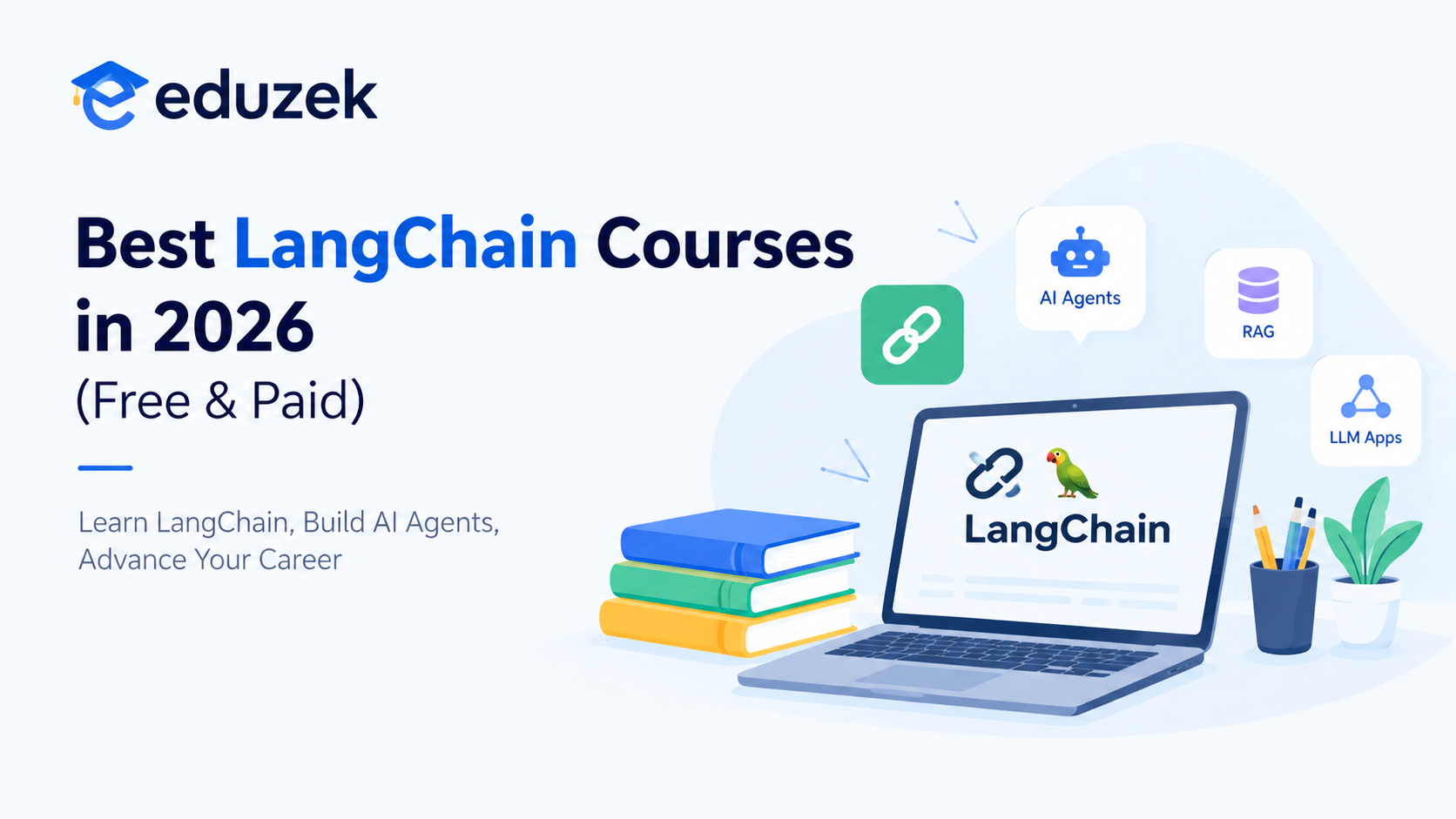
Best LangChain Courses in 2026 (Free & Paid) | Eduzek
Introduction
Generative AI is transforming how businesses build applications, automate workflows, and interact with information. As large language models (LLMs) become more powerful, developers need practical frameworks that help them turn these models into useful, reliable applications. One of the most popular frameworks in this space is LangChain.
If you want to build AI chatbots, retrieval-augmented generation (RAG) applications, intelligent assistants, or AI agents, choosing one of the best LangChain courses in 2026 can help you develop the skills required to work on real-world projects.
However, not every course offers the same learning experience. Some focus on the fundamentals of LangChain, while others teach document processing, vector databases, LangGraph, agent development, deployment, and production monitoring. Some courses are completely free, while others offer structured learning paths, assessments, or paid certificates.
In this guide, we compare the best free and paid LangChain courses, including LangChain Academy, Coursera programs, DeepLearning.AI courses, and comprehensive project-based training options. We also explain how to choose a LangChain full course, find a useful crash course, and prepare for LangChain certification.
Whether you are a student, software developer, data scientist, working professional, or aspiring AI engineer, this guide will help you identify the right learning path.
What Is LangChain?
LangChain is an open-source framework that helps developers build applications powered by large language models. It provides components and integrations for connecting LLMs with prompts, external data, APIs, tools, and application workflows.
Instead of writing every integration from scratch, developers can use LangChain's abstractions to organize model interactions and build applications more efficiently.
Common LangChain use cases include:
- AI chatbots and conversational assistants
- Retrieval-augmented generation applications
- Chat with PDF and document applications
- AI-powered search systems
- Tool-using AI agents
- Customer support automation
- Knowledge management systems
- Intelligent research assistants
- Business process automation
LangChain is also part of a broader ecosystem that includes LangGraph for orchestrating stateful agent workflows and LangSmith for evaluating, tracing, and monitoring AI applications.
Understanding these tools is particularly useful if you want to move beyond basic chatbot development and build AI systems that can retrieve information, use tools, and complete multi-step tasks.
Why Learn LangChain in 2026?
Learning LangChain can help you develop practical skills for building modern AI applications. Rather than limiting yourself to writing prompts for an LLM, you can learn how to connect models to business data, integrate external tools, and manage more complex workflows.
Here are some reasons to consider learning LangChain in 2026.
1. Build practical generative AI applications
LangChain helps you connect language models with documents, APIs, databases, and other information sources. This makes it useful for building applications that answer questions using business-specific information rather than relying only on a model's existing knowledge.
2. Develop RAG applications
Retrieval-augmented generation is widely used to build AI systems that retrieve relevant information before generating an answer.
With LangChain, you can learn document loading, text splitting, embeddings, vector search, retrieval, and response generation.
These concepts are useful for building internal knowledge assistants, customer support tools, and document question-answering applications.
3. Learn AI agent development
AI agents can use tools, process information, and execute multi-step workflows. LangChain provides agent-building abstractions, while LangGraph supports more controlled, stateful workflows.
These capabilities are useful for developers exploring agentic AI, workflow automation, and intelligent applications.
4. Improve your AI engineering skills
LangChain knowledge can complement Python programming, API integration, prompt engineering, database management, and machine learning fundamentals.
A structured course can help you combine these skills into working applications rather than learning each concept independently.
5. Prepare for advanced AI training
LangChain is a useful starting point for exploring broader generative AI and agentic AI development.
If your goal is to develop end-to-end AI solutions, you can complement your LangChain learning with generative AI training in Hyderabad and explore agentic AI course training in India.
Best LangChain Courses in 2026: Quick Comparison
The following courses and learning resources are worth considering based on their learning format, subject coverage, and suitability for different experience levels.
| CoursePlatformCostBest For | |||
| Introduction to LangChain – Python | LangChain Academy | Free | Beginners and Python developers |
| Introduction to LangGraph – Python | LangChain Academy | Free | Agent workflows and state management |
| LangChain Certified Agent Engineer preparation | LangChain Academy | Free preparation courses; paid exam | Developers seeking an official credential |
| LangChain for LLM Application Development | DeepLearning.AI | Free course availability; check current access | Quick introduction to core concepts |
| Chat with Your Data | DeepLearning.AI | Free course availability; check current access | Document-based AI applications |
| Agentic AI with LangChain and LangGraph | Coursera | Paid access may apply | Structured learning and agent development |
| Retrieval-Augmented Generation with LangChain | DataCamp | Free to start; full access may require a subscription | RAG-focused learning |
| Building RAG Applications with LangChain | freeCodeCamp | Free | Project-based self-learning |
Important: Course availability, pricing, access conditions, curricula, and certificates can change. Check the provider's official course page before enrolling.
1. LangChain Academy: Best Free Official LangChain Course
Best for: Beginners, Python developers, and learners who want to study directly from the LangChain ecosystem.
Price: Free course content.
Learning format: Self-paced online learning.
LangChain Academy is one of the best starting points for anyone looking for a free LangChain full course or a structured introduction to AI agent development.
The academy offers learning resources organized around building, testing, deploying, and monitoring agents. Its courses cover LangChain, LangGraph, Deep Agents, and LangSmith.
Because the content comes from the LangChain ecosystem, it is a useful starting point for understanding the framework's intended workflows and current development practices.
What will you learn?
Depending on the selected course, you can explore:
- Building AI agents with LangChain
- Working with language models and messages
- Integrating tools into agent workflows
- Building applications using LangGraph
- Managing state in agent workflows
- Testing and evaluating AI applications
- Deploying agents
- Monitoring AI application performance
Who should choose LangChain Academy?
Choose LangChain Academy if you want to begin learning without paying for course content, explore official framework concepts, and develop a foundation before attempting more advanced projects.
It is especially suitable for self-directed learners who are comfortable following technical tutorials and experimenting with code.
Official resource: https://academy.langchain.com/
Is LangChain Academy certification free?
LangChain Academy provides free learning content, but completing a course does not automatically mean you receive a professional certification.
The official LangChain Certified Agent Engineer exam is a separate paid assessment. Therefore, distinguish between completing free Academy courses and earning the formal certification.
2. DeepLearning.AI: Best LangChain Crash Course for Beginners
Best for: Beginners who want to understand the basic concepts quickly.
Price: The introductory courses have been offered free, but verify current availability.
Learning format: Short lessons and practical coding exercises.
If you are searching for a LangChain crash course, DeepLearning.AI is worth considering. Its short-form courses introduce key concepts without requiring you to commit to a long training program immediately.
Two well-known options are LangChain for LLM Application Development and LangChain: Chat with Your Data.
LangChain for LLM Application Development
This course introduces the process of building LLM applications using LangChain. It covers foundational concepts such as models, prompts, output parsing, chains, and conversational application patterns.
It is a useful starting point for developers who want to understand how LangChain fits into the broader process of building generative AI applications.
LangChain: Chat with Your Data
This course focuses on applications that let users ask questions about their own information.
You can explore concepts related to document ingestion, retrieval, embeddings, and connecting an LLM to external knowledge.
These concepts provide a foundation for building document assistants and RAG applications.
Advantages
- Short lessons that are easier to fit into a busy schedule
- Practical introductions to LLM application development
- Useful starting points before advanced coursework
- Opportunities to understand RAG fundamentals
Limitations
A short course is not a substitute for a comprehensive development program. You may need additional learning resources to understand modern agent workflows, evaluation, deployment, and production-level reliability.
3. LangChain Academy LangGraph Course: Best for AI Agent Workflows
Best for: Developers who want to move from basic LLM applications to more controlled agent workflows.
Price: Free course content.
LangGraph is designed for building stateful, multi-step agent applications. It provides mechanisms for defining workflows, managing state, coordinating steps, and incorporating human intervention when required.
Although LangChain and LangGraph are closely related, they serve different purposes. LangChain helps developers build LLM-powered applications and agents, while LangGraph provides more explicit control over complex, stateful execution.
Topics you can explore
- Graph-based agent workflows
- Nodes and edges
- State management
- Multi-step execution
- Human-in-the-loop workflows
- Persistent state and memory
- Agent evaluation and debugging
- Workflow control and error handling
Why is LangGraph important?
A basic chatbot may need only a prompt and a model response. A more advanced business application might need to retrieve documents, call an API, verify information, request human approval, and continue execution.
LangGraph provides tools for structuring these more complex workflows.
If your objective is to become an AI engineer who can build practical agentic applications, learning LangGraph alongside LangChain is a valuable next step.
Official resource: https://academy.langchain.com/
4. Coursera: Best for Structured LangChain Learning
Best for: Learners who prefer organized modules, guided coursework, and a platform-based learning experience.
Price: Varies by course, subscription, and access arrangement.
Coursera is another option for anyone looking for LangChain courses with structured lessons and potential certificate pathways.
Its catalog includes programs related to LangChain, LangGraph, RAG, and agentic AI. One relevant option is IBM's Agentic AI with LangChain and LangGraph.
What can you learn?
Depending on the selected program, the curriculum may cover:
- Foundations of generative AI
- LangChain application development
- LangGraph and agentic workflows
- Retrieval-augmented generation
- Tool integration
- Python programming
- AI application development
Advantages of learning LangChain through Coursera
Coursera can be useful if you prefer a more structured learning experience than independent tutorials.
Some programs combine multiple related topics into a single learning path, making it easier to progress from foundational concepts to more advanced AI engineering skills.
Depending on the course, you may also receive a course completion certificate or a professional certificate.
Is there a free LangChain course on Coursera?
Some Coursera courses provide free previews, while other learning options may offer temporary trial access or financial assistance. However, full course access and certificates are not necessarily free.
Before enrolling, confirm whether the course is available at no cost, whether graded assignments are included, and whether you must pay to receive the certificate.
5. LangChain Certified Agent Engineer: Best for Professional Certification
Best for: Developers who already understand AI application development and want to demonstrate their agent engineering knowledge.
Course content: Free preparation courses are available through LangChain Academy.
Certification exam: Paid.
For learners specifically searching for LangChain Academy certification, the LangChain Certified Agent Engineer credential is an important option to investigate.
Unlike a basic course completion certificate, this credential involves a separate proctored assessment focused on agent engineering.
The certification covers four broad areas of the agent development lifecycle:
- Building agents
- Testing agents
- Deploying agents
- Monitoring agents
These areas reflect the practical requirements of building AI agents that go beyond a successful demonstration and can be evaluated and operated more systematically.
What is the certification exam format?
The published exam information describes a 40-question multiple-choice examination, with 28 correct answers required to pass. The stated exam duration is 120 minutes, with approximately 135 minutes of total seat time.
The certification is valid for 24 months, according to the official certification information.
Check the official page for the latest exam rules, eligibility requirements, pricing, and scheduling details
How should you prepare?
A sensible preparation path is to:
- Complete the official LangChain foundation course.
- Learn LangGraph and agent workflow fundamentals.
- Build working AI agents with tools.
- Practice testing and evaluating agent behavior.
- Understand deployment and monitoring.
- Review the official exam guide before scheduling the assessment.
Is LangChain certification free?
The preparation material can be accessed free of charge, but the formal LangChain Certified Agent Engineer exam is paid.
This distinction matters if you are looking specifically for LangChain certification free of cost. You can develop skills and complete free coursework without necessarily earning the paid professional credential.
6. DataCamp: Best for Learning Retrieval-Augmented Generation with LangChain
Best for: Developers interested in document search, knowledge assistants, and RAG applications.
Price: Free introductory access may be available; full access depends on the current subscription arrangement.
RAG is one of the most useful patterns for applications that need to answer questions using external information. DataCamp offers courses related to LangChain and retrieval-augmented generation.
A relevant option is Retrieval-Augmented Generation with LangChain.
What will you learn?
A RAG-focused course can help you understand:
- Loading documents from different sources
- Splitting text into manageable chunks
- Generating embeddings
- Storing and retrieving vector representations
- Finding relevant information for a user query
- Passing retrieved context to an LLM
- Improving the quality of generated answers
Who should choose DataCamp?
DataCamp is worth considering if you prefer guided exercises and want to focus on building knowledge-grounded applications.
It can also complement a general LangChain course by giving you more practice with document retrieval and information processing.
7. freeCodeCamp: Best Free Project-Based LangChain Learning
Best for: Self-taught developers who prefer longer tutorials and practical demonstrations.
Price: Free.
freeCodeCamp is a useful option for learners who want to study LangChain through extended tutorials and build-along projects.
Long-form tutorials can help you see how different components fit together in a complete application instead of studying isolated concepts.
Topics to explore
Depending on the tutorial, you may encounter:
- Setting up a LangChain project
- Connecting an LLM to an application
- Processing documents
- Creating embeddings
- Implementing retrieval
- Building RAG pipelines
- Integrating tools
- Testing the application
Advantages
FreeCodeCamp is particularly useful for learners who want to experiment with code and learn at their own pace.
However, long-form videos can become outdated as libraries and APIs evolve. Check publication dates, repository updates, and the official documentation before copying code into a new project.
8. Udemy: Best for Comprehensive Paid LangChain Courses
Best for: Learners who prefer a single, structured course with extended video lessons and projects.
Price: Varies by instructor, course, and promotional offer.
Udemy hosts courses on LangChain, LangGraph, RAG, and agentic AI development.
A comprehensive paid course can be useful if you prefer having multiple topics organized into one curriculum rather than combining several independent tutorials.
What should you look for?
When evaluating a LangChain full course on Udemy, look for a curriculum that includes:
- Python and LLM application fundamentals
- Current LangChain APIs
- Prompt and model integration
- Document processing and RAG
- Vector databases and embeddings
- Tool calling and AI agents
- LangGraph workflows
- Testing and debugging
- Practical end-to-end projects
How to choose a good Udemy course
Do not select a course solely because it has a high rating or a large number of hours.
Instead, check when the course was last updated, whether its examples use current APIs, whether project files are available, and whether the instructor explains how to troubleshoot common errors.
A shorter course with updated examples and practical assignments may provide more value than a longer course that relies on outdated code.
Official resource: https://www.udemy.com/
Best LangChain Courses in 2026: Which One Should You Choose?
The best course depends on your experience, learning goals, and budget.
| Your GoalRecommended Option | |
| Learn LangChain for free | LangChain Academy |
| Complete a quick introduction | DeepLearning.AI |
| Build stateful AI agents | LangChain Academy's LangGraph courses |
| Learn through structured modules | Coursera |
| Earn a formal LangChain credential | LangChain Certified Agent Engineer |
| Focus on RAG and document search | DataCamp |
| Follow long-form free tutorials | freeCodeCamp |
| Learn through a comprehensive paid course | Udemy |
Our recommendation: Start with free foundational material before paying for an advanced course or certification. Once you understand the fundamentals, choose a program that helps you build complete projects and develop skills in testing, evaluation, and deployment.
If you are targeting an AI engineering role, prioritize hands-on work over simply completing multiple introductory courses.
LangChain Full Course vs. LangChain Crash Course: Which Is Better?
A LangChain full course and a LangChain crash course serve different purposes.
A crash course introduces the essential concepts quickly. A full course provides more time for practice, deeper explanations, and end-to-end projects.
LangChain crash course
A crash course is appropriate if you:
- Already understand Python basics.
- Have some experience working with APIs.
- Want a quick introduction to LangChain.
- Need to understand the basic structure of an LLM application.
- Want to evaluate whether you should pursue advanced training.
A crash course may cover model integration, prompts, basic chains or agent patterns, and a small demonstration project.
LangChain full course
A full course is better if you:
- Are new to LLM application development.
- Want to understand RAG in depth.
- Need hands-on experience with vector databases.
- Want to build agents that use tools.
- Need to learn testing and debugging.
- Want to develop deployable portfolio projects.
A comprehensive course should take you beyond basic examples and explain how to handle errors, evaluate responses, protect sensitive data, and monitor application behavior.
Which is better for beginners?
If you are a beginner, start with a crash course to understand the terminology and workflow. Then move to a comprehensive learning path that includes projects.
If you already have experience with Python and LLM APIs, you may be able to skip some
introductory material and focus on LangGraph, RAG, and production-oriented agent engineering.
What Should a Good LangChain Full Course Cover?
Not all courses marketed as a LangChain full course offer the same depth. Before enrolling, review the curriculum against the following topics.
1. Python and LLM fundamentals
You should understand Python basics, API requests, environment variables, and the fundamentals of interacting with language models.
You should also know how to manage API keys securely and handle basic errors.
2. LangChain fundamentals
Learn how to configure model integrations, structure prompts, manage messages, process outputs, and organize LLM application logic.
You should understand how these components fit together in an application.
3. Document loading and processing
Learn how to ingest information from PDFs, text files, web pages, and other supported sources.
You should understand text splitting, metadata, document structure, and the importance of preparing clean input data.
4. Embeddings and vector databases
Embeddings represent text as numerical vectors that can be used for similarity-based retrieval.
A useful course should explain how embeddings are generated, how vector stores work, and how retrieved documents can support relevant responses.
5. Retrieval-augmented generation
RAG combines information retrieval with language generation.
You should learn how to retrieve relevant content, construct context for the model, and evaluate whether the generated response is grounded in the supplied information.
6. Tools and agent development
Learn how agents use tools such as search, APIs, databases, or application-specific functions.
A good course should also discuss validation, tool permissions, error handling, and situations where a controlled workflow is more appropriate than an autonomous agent.
7. LangGraph
LangGraph becomes particularly useful when your application needs explicit state management, conditional execution, multi-step workflows, retries, or human approval.
Look for projects that demonstrate these capabilities in a realistic scenario.
8. Evaluation and deployment
Building a working prototype is only one part of AI engineering.
A comprehensive course should introduce testing, tracing, evaluation datasets, latency and cost considerations, deployment practices, and monitoring.
These topics help prepare you to build applications that can be maintained beyond the initial demonstration.
Best LangChain Course Reddit Recommendations: What Should You Look For?
People searching for the best LangChain course Reddit discussions are often trying to find practical recommendations from developers who have already built AI applications.
Community discussions can be useful, but recommendations depend on the user's background, the age of the tutorial, and the kind of project they want to build.
Rather than relying on a single Reddit recommendation, compare community advice against the following criteria.
1. Check whether the course is up to date
LangChain and related tools evolve. Look for tutorials that use current documentation and APIs rather than examples that depend on deprecated methods.
2. Prioritize projects over passive watching
A course becomes more useful when you build something yourself. Look for examples involving document retrieval, tool calling, structured outputs, or stateful workflows.
3. Use official documentation to verify code
Even highly recommended community tutorials can become outdated. Compare their examples with the official documentation before implementing them.
4. Choose a course that matches your experience
Beginners may benefit from a short introduction before tackling advanced RAG or agent orchestration. Experienced developers may prefer project-based material focused on evaluation, deployment, and reliability.
5. Look for complete application examples
A useful course should demonstrate more than a successful model response. It should explain configuration, error handling, retrieval quality, testing, and other considerations relevant to the intended application.
For additional community perspectives, explore the LangChain community on Reddit.
Our takeaway: Use Reddit discussions to discover useful learning resources, but use curriculum quality, project depth, documentation accuracy, and your own learning objectives to make the final decision.
How to Learn LangChain for Free in 2026
You do not need to purchase a course immediately to start learning LangChain.
A structured self-learning plan can help you understand the basics and build a small project before deciding whether advanced training is necessary.
Week 1: Learn the fundamentals
Start with Python, LLM APIs, prompts, messages, and basic LangChain concepts.
Your goal should be to build a simple application that accepts a question and returns a response from an LLM.
Practice project: Create a basic conversational assistant.
Week 2: Learn document processing and RAG
Explore document loaders, text splitting, embeddings, vector stores, and retrieval.
Your goal should be to understand how an application can use external documents to answer questions.
Practice project: Build a chatbot that answers questions about a collection of PDF documents.
Week 3: Learn tools and agent workflows
Study tool calling, structured outputs, and agent behavior. Begin exploring LangGraph if you need more explicit workflow control.
Your goal should be to create an application that can select and use an appropriate tool for a task.
Practice project: Build an assistant that searches a knowledge base and calls a simple external API.
Week 4: Test and improve your application
Add error handling, logging, evaluation examples, and basic monitoring.
Test your application using different questions and check whether its answers are accurate, relevant, and grounded in the information it receives.
Practice project: Improve your document assistant with evaluation checks, better retrieval, and a simple deployment.
This four-week plan is a suggested learning schedule rather than a guarantee of mastery. Your progress will depend on your programming experience, available study time, and project complexity.
Best LangChain Projects to Build After Completing a Course
Projects help you apply the concepts learned in a course and demonstrate your skills to potential employers or clients.
Here are five project ideas to consider.
1. PDF question-answering assistant
Build an application that allows users to upload documents and ask questions about their content.
Skills demonstrated: Document processing, embeddings, vector retrieval, RAG, and response generation.
2. Customer support knowledge assistant
Create an assistant that answers customer questions using a curated knowledge base.
Skills demonstrated: RAG, prompt design, retrieval evaluation, and response validation.
3. AI research assistant
Build an assistant that gathers information from permitted sources, organizes findings, and produces a structured summary.
Skills demonstrated: Tool calling, multi-step workflows, structured outputs, and evaluation.
4. Business workflow assistant
Create an agent that processes a request, retrieves relevant information, and calls approved tools to complete selected tasks.
Skills demonstrated: Agent design, API integration, workflow control, and error handling.
5. Multi-step LangGraph agent
Build a workflow that routes a task through multiple stages, maintains state, and requests human approval before sensitive actions.
Skills demonstrated: LangGraph, state management, conditional execution, and human-in-the-loop design.
When building portfolio projects, document the problem, architecture, technology choices, testing process, and limitations. A well-explained project can demonstrate practical understanding more effectively than a list of completed courses alone.
LangChain vs. LangGraph vs. LangSmith: What's the Difference?
These tools are related, but they solve different problems.
| ToolPrimary PurposeExample Use Case | ||
| LangChain | Building LLM-powered applications and agents | Creating a chatbot that uses tools |
| LangGraph | Orchestrating stateful, multi-step agent workflows | Building an agent with branching logic and human approval |
| LangSmith | Observing, evaluating, testing, and monitoring AI applications | Debugging agent traces and measuring response quality |
You do not need to master every tool on your first day.
Start with the fundamentals of LangChain, then explore LangGraph when your applications require more control over execution. Learn LangSmith when you need to understand application behavior, evaluate quality, or improve reliability.
Together, these tools can support a broader AI engineering learning path.
Is LangChain Enough to Become an AI Engineer?
LangChain is a valuable framework to learn, but it is not a complete substitute for broader AI engineering knowledge.
To build reliable AI applications, you should also develop skills in:
- Python programming
- APIs and backend development
- Prompt engineering
- Retrieval-augmented generation
- Embeddings and vector databases
- Data preparation and processing
- Tool calling and agent workflows
- Testing and evaluation
- Application deployment
- Security and responsible AI practices
The depth you need depends on the role you are targeting.
For example, a developer building an internal document assistant may focus heavily on RAG and backend integration. Someone developing advanced autonomous workflows may need stronger knowledge of state management, evaluation, tool permissions, and failure recovery.
If you want to expand from LangChain fundamentals into a broader AI skill set, explore Eduzek's Generative AI Training in Hyderabad.
For learners specifically interested in intelligent agents and multi-step automation, Eduzek's Agentic AI Course Training in India is another relevant learning option to explore.
Review the current curriculum and training format to determine whether the program matches your goals.
How to Choose the Best LangChain Course for Your Career
Before choosing a course, identify the outcome you want to achieve.
If you are a student
Start with free resources and build foundational projects. Focus on Python, LLM APIs, RAG, and basic agent development before investing in a professional certification.
If you are a working developer
Choose a course that focuses on practical application development. You may benefit more from advanced RAG, LangGraph, testing, and deployment than from repeating basic programming concepts.
If you are a data scientist
Prioritize retrieval, embeddings, data processing, evaluation, and integration with existing data systems.
If you want to become an AI engineer
Look for a structured learning path that combines LLM fundamentals, LangChain, LangGraph, RAG, tool integration, testing, and deployment.
If you want a professional credential
Review the requirements for the LangChain Certified Agent Engineer exam and prepare using the official learning material. Remember that course completion and formal certification are separate outcomes.
If you have a limited budget
Begin with LangChain Academy and other free learning resources. Pay for a course or certification only when it provides a clear benefit that aligns with your goals.
Common Mistakes to Avoid When Learning LangChain
Even a good course can be less effective if you approach learning without a clear plan.
1. Learning only through videos
Watching tutorials without writing code makes it difficult to develop independent problem-solving skills.
Better approach: Recreate each example, change the inputs, introduce new requirements, and troubleshoot errors yourself.
2. Ignoring API changes
Older tutorials may rely on outdated integrations or methods.
Better approach: Verify examples against current documentation and prefer recently maintained course materials.
3. Skipping RAG fundamentals
Many practical AI applications need access to external information.
Better approach: Learn document ingestion, retrieval, embeddings, and evaluation before attempting complex knowledge assistants.
4. Building agents without evaluation
An agent that works once may fail on different inputs or under unexpected conditions.
Better approach: Test different scenarios, record failures, evaluate outputs, and introduce suitable safeguards.
5. Collecting certificates without building projects
Certificates can show that you completed a learning activity, but they do not necessarily demonstrate your ability to build an application.
Better approach: Pair coursework with practical projects and explain your technical decisions clearly.
6. Assuming every task requires an AI agent
Some tasks are better handled by a predictable workflow rather than an autonomous system.
Better approach: Use the simplest architecture that meets the requirements. Add agent behavior when it provides a meaningful advantage.
Frequently Asked Questions About the Best LangChain Courses in 2026
1. Which is the best LangChain course in 2026?
LangChain Academy is a strong starting point for learners who want free, official learning resources. DeepLearning.AI is useful for a short introduction, Coursera offers structured learning options, and DataCamp provides RAG-focused training. The best choice depends on your experience, budget, and project goals.
2. Is there a free LangChain full course?
Yes. LangChain Academy provides free courses covering LangChain, LangGraph, and related agent engineering topics. You can combine these resources with free tutorials and official documentation to develop a broader understanding of the framework.
However, the available free courses may be modular rather than a single course covering every topic from beginner to production engineer.
3. Where can I find a LangChain crash course?
DeepLearning.AI offers short introductory courses on LangChain and LLM application development. These are useful for understanding core concepts quickly. After completing a crash course, consider a more comprehensive learning path that includes RAG, agent workflows, and testing.
4. Is LangChain available on Coursera?
Yes. Coursera lists courses related to LangChain, LangGraph, RAG, and agentic AI, including IBM's Agentic AI with LangChain and LangGraph. Availability, pricing, and certificate conditions vary by program.
5. Can I get LangChain certification for free?
You can study through free LangChain Academy courses, but the formal LangChain Certified Agent Engineer exam is paid. Completing free training does not automatically award the professional certification.
6. What is LangChain Academy certification?
The LangChain Certified Agent Engineer credential is a formal assessment focused on building, testing, deploying, and monitoring agents. The certification exam is separate from the free Academy coursework. Refer to the official certification page for the latest details.
7. Which LangChain course is best for beginners?
Beginners can start with LangChain Academy's introductory Python course or a short DeepLearning.AI course. Basic Python knowledge and familiarity with APIs will make the learning process easier.
8. Is LangChain difficult to learn?
The difficulty depends on your programming experience. Basic LangChain applications may be manageable for developers who understand Python and APIs. Advanced RAG pipelines, stateful agent workflows, evaluation, and production deployment require additional practice.
9. How long does it take to learn LangChain?
You may understand the fundamentals within a few days or weeks, depending on your background and study time. Developing confidence with RAG, agent workflows, testing, and deployment generally requires additional hands-on practice. There is no fixed timeline that guarantees professional proficiency.
10. Should I learn LangChain or LangGraph first?
Start with LangChain fundamentals if you are new to LLM application development. Learn LangGraph when you need explicit control over stateful workflows, conditional execution, and multi-step agent behavior. The two technologies complement each other.
11. Is LangChain enough to build AI agents?
LangChain provides tools for building agents, but reliable agent applications also require appropriate model selection, tool integration, evaluation, error handling, security, and monitoring. LangGraph and LangSmith can help address some of these needs.
12. What should I build after completing a LangChain course?
Start with a document question-answering assistant or a RAG-based chatbot. Once you understand retrieval and response generation, progress to tool-using agents, multi-step workflows, and applications with evaluation and monitoring.
13. Which is the best LangChain course according to Reddit?
There is no universally accepted Reddit recommendation. Official LangChain Academy courses, updated project-based tutorials, and practical RAG courses are useful options to compare. Check recent community discussions and validate the course material against current documentation.
14. Do I need to pay to learn LangChain?
No. You can begin with free courses, documentation, and community tutorials. Paid courses may provide a more structured curriculum, while a paid certification may be useful if you specifically want the relevant professional credential.
15. Can LangChain help me get an AI engineering job?
Learning LangChain can support your AI engineering preparation, but employment outcomes depend on your overall skills, experience, portfolio, and the requirements of the role. Combine framework knowledge with Python, API integration, RAG, evaluation, and deployment experience.
Conclusion: Start Learning LangChain in 2026
Choosing among the best LangChain courses in 2026 becomes easier when you understand your learning goals.
If you want to start for free, LangChain Academy is a practical first choice. If you prefer a short introduction, explore DeepLearning.AI. For structured coursework, compare Coursera programs, and consider DataCamp or project-based tutorials if your primary goal is building RAG applications.
For learners interested in professional certification, distinguish free preparation resources from the paid LangChain Certified Agent Engineer examination.
Most importantly, do not stop at completing a course. Build applications, test your code, evaluate results, and learn how to improve reliability. These practical skills will help you progress from understanding LangChain concepts to developing useful AI applications.
If you want to expand your knowledge beyond individual framework tutorials, explore Eduzek's Generative AI Training in Hyderabad for broader generative AI learning opportunities, or learn more about Agentic AI Course Training in India if your goal is to work with AI agents and intelligent workflows.
Your next step: Choose a course that matches your current level, build one practical project, and use that project to identify the next skills you need to develop
Tags :
- LangChain Courses 2026
- Best LangChain Courses
- LangChain Full Course
- LangChain Crash Course
- LangChain Certification
- Free LangChain Courses
- LangChain Academy Certification
- LangChain Coursera
- Best LangChain Course Reddit
- LangChain Tutorial
- Learn LangChain
- LangGraph Course
- AI Agent Development
- Generative AI Training
- Agentic AI Course
- RAG with LangChain
- AI Engineering Courses
- LangChain for Beginners
- Eduzek
Related Course
Related Articles
October 5, 2026