Call us: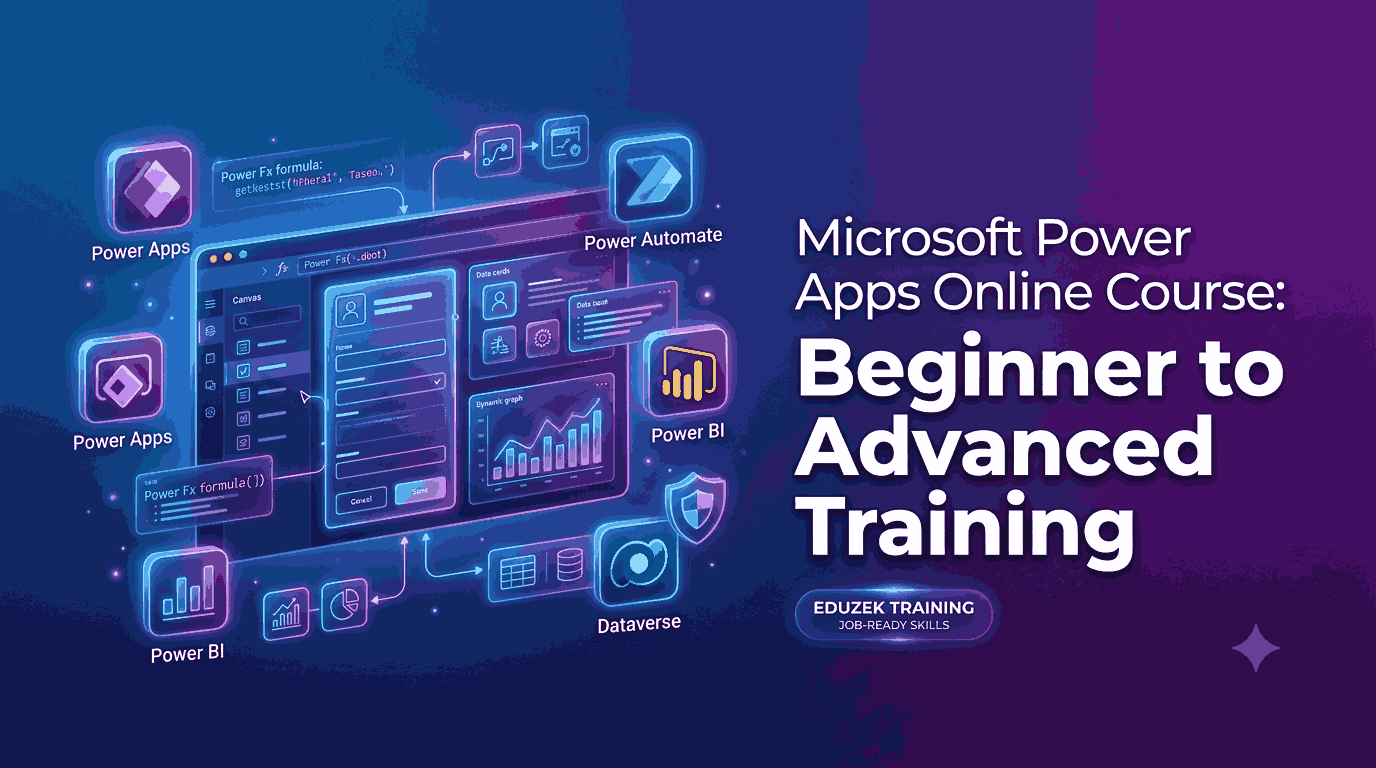
Power Apps Course Online for Beginners: What You'll Learn, Uses & Career Opportunities
In today’s fast-paced digital landscape, organizations are constantly seeking ways to digitize workflows, automate repetitive tasks, and build custom software solutions without waiting months for traditional development cycles. This demand has fueled a massive surge in low-code application development—a market transformation designed to empower both IT professionals and business users to create custom business applications rapidly.
At the center of this low-code revolution is Microsoft Power Apps, a versatile platform within the Microsoft Power Platform suite. Microsoft Power Apps allows users to build tailored, mobile- and web-friendly applications using intuitive visual interfaces, drag-and-drop controls, and simple formula languages like Power Fx. By bridging the gap between non-technical business knowledge and technical execution, Power Apps has quickly become an essential tool for modern enterprise digital transformation.
Because low-code platforms are reshaping how businesses operate, low-code skills are attracting a wide range of professionals and learners. From software developers and IT specialists looking to speed up development to business analysts, operations managers, and non-IT professionals aiming to solve workplace inefficiencies, people across various industries are seeking to upskill. To meet this demand, learners are increasingly searching for Power Apps course online options. Online training offers the flexibility to gain hands-on expertise, master key Power Platform components, and earn valuable certifications—all without disrupting existing work or academic schedules.
What You'll Learn in This Guide:
- Core Concepts & Capabilities: What Microsoft Power Apps is, how it functions, and where it fits within the broader Microsoft Power Platform ecosystem.
- Real-World Applications: What you can build using Power Apps and practical use cases across departments like HR, Finance, Operations, and Sales.
- Prerequisites & Learning Curve: Whether beginners or non-programmers need prior coding experience to start learning.
- Curriculum Breakdown: A complete look at the technical skills covered in a comprehensive Power Apps online training program—including Canvas Apps, Model-Driven Apps, Dataverse, and Power Automate integration.
- Career Growth & Opportunities: Job roles, market demand, and salary expectations for Power Apps and Power Platform professionals.
- Selecting the Right Training: Key criteria to evaluate when choosing an online course to ensure maximum practical learning and career impact.
What Is Microsoft Power Apps?
Microsoft Power Apps is a suite of apps, services, connectors, and a robust data platform designed to provide a rapid development environment for building custom applications tailored to business needs. As a core offering within the Microsoft low-code ecosystem, Power Apps enables organizations to transform manual, repetitive tasks into digital, automated, and mobile-friendly processes.
It bridges the gap between professional developers and business users (often called "citizen developers"), allowing anyone to build feature-rich, enterprise-grade applications without writing traditional complex code.
What Is Power Apps Used For?
Power Apps is used to streamline internal business operations, modernize outdated legacy systems, and solve everyday operational challenges. Organizations across industries leverage Power Apps for:
- Internal Business Applications: Building custom tools for expense reporting, employee onboarding, IT helpdesk ticketing, and leave requests.
- Field Operations & Data Collection: Creating mobile apps for field workers to perform site inspections, capture photos, record geotags, and log maintenance reports on the go.
- Process Automation & Approvals: Replacing paper-based forms or email-heavy approval chains with digital submit-and-approval workflows.
- Inventory & Asset Management: Tracking equipment, office supplies, or warehouse inventory with built-in barcode scanning and real-time database updates.
- Customer & Sales Tracking: Developing lightweight CRM tools to manage leads, track client interactions, and log sales activities.
How Does Microsoft Power Apps Work?
Microsoft Power Apps simplifies application creation through a visual, drag-and-drop studio interface combined with flexible backend connectivity.
- Visual Design Studio: Designers build user interfaces by dragging controls—such as buttons, text boxes, galleries, and forms—onto a visual canvas.
- Power Fx (Formula Language): Instead of writing traditional programming code, application logic is driven by Power Fx—an open-source, low-code formula language heavily inspired by Microsoft Excel formulas.
- Pre-Built Connectors: Power Apps easily connects to over 1,000 data sources—including SharePoint, Microsoft Excel, SQL Server, Salesforce, Dynamics 365, and custom APIs—allowing apps to fetch and update data seamlessly.
- Cross-Platform Accessibility: Once published, apps automatically adjust layout responsiveness and run seamlessly on web browsers, iOS, and Android mobile devices.
- AI-Assisted Co-creation: Built-in generative AI and Copilot features allow creators to build data tables, layout screens, and generate logic simply by describing what they need in natural language.
Power Apps and the Microsoft Power Platform
Power Apps does not operate in isolation; it is a foundational component of the Microsoft Power Platform—a collection of low-code tools that work together to deliver end-to-end digital solutions.
- Power Automate: Works alongside Power Apps to handle background workflows, automated email notifications, multi-level approvals, and system integrations triggered by user actions inside the app.
- Power BI: Visualizes business data collected through Power Apps, turning application entries into interactive reporting dashboards for business leadership.
- Power Pages: Extends low-code application capabilities to external, public-facing web portals for external clients, vendors, or partners.
- Microsoft Dataverse: Serves as the cloud database engine powering the entire platform, providing standardized data tables, enterprise security, business rules, and role-based permissions.
What Can You Build With Microsoft Power Apps?
Microsoft Power Apps allows organizations to build a wide range of custom, cross-platform mobile and web applications designed to streamline operations and replace manual workflows. From simple forms to complex, data-heavy enterprise platforms, here are key operational applications you can build using Power Apps:
- Employee Applications: Self-service portals for desk booking, office equipment requests, internal job postings, employee recognition, and shift scheduling.
- HR Applications: Integrated tools for seamless onboarding, leave/time-off tracking, performance reviews, employee feedback collection, and training course management.
- Customer Management Applications: Custom CRM extensions, client interaction trackers, event registration tools, and customer support ticket logging systems.
- Inventory Management Applications: Real-time asset tracking platforms featuring mobile barcode scanning, stock level alerts, tool checkout systems, and warehouse auditing tools.
- Approval Systems: Automated multi-tier request platforms for purchase orders, expense reports, document sign-offs, and budget approvals with push notifications.
- Inspection Applications: Mobile-first tools for facility management, safety check compliance, quality assurance audits, and incident reporting complete with photo attachment capabilities.
- Field Service Applications: Custom mobile interfaces for field technicians to view job dispatch schedules, record GPS location data, capture electronic signatures, and log service reports offline.
- Internal Business Applications: Custom operational command centers, vendor management systems, compliance trackers, and cross-departmental project hubs.
- Data Collection Applications: Digital survey forms, event check-in systems, field data logging tools, and automated survey engines that eliminate paper-based recordkeeping.
Power Apps Use Cases in Real-World Business
Microsoft Power Apps enables organizations to replace slow, paper-based, and fragmented processes with fast, custom-built digital applications. Across departments, business leaders leverage Power Apps to automate workflows, unify enterprise data, and improve operational productivity.
- Human Resources (HR): Modernizes employee experiences with self-service apps for onboarding task management, leave requests, performance evaluations, employee recognition programs, and policy acknowledgment tracking.
- Sales: Provides sales reps with mobile CRM apps to log client meetings, manage leads on the go, generate rapid sales quotes, and track team pipeline activity in real time.
- Finance: Simplifies financial operations with digital expense submission apps, budget request portals, invoice routing tools, and petty cash management interfaces.
- Operations: Streamlines core business processes using custom dispatch boards, equipment scheduling apps, facility management trackers, and shift scheduling software.
- Customer Service: Empowers support teams with custom ticketing tools, customer feedback capture portals, service escalation management dashboards, and client account lookup apps.
- Procurement: Accelerates purchasing cycles through vendor onboard tracking tools, purchase requisition forms, contract renewal monitors, and supplier performance scoring apps.
- Inventory: Enhances stock visibility with real-time inventory count apps featuring built-in barcode/QR code scanning, low-stock alert triggers, and automated warehouse material checkout.
- Field Operations: Equips mobile workforce members with offline-capable apps for site audits, safety compliance checks, geotagged progress reporting, photo uploads, and client digital signature capture.
- Approvals: Replaces slow email chains with unified approval hubs that centralize multi-tier sign-off requests for expenses, documents, discounts, and capital expenditures with instant push notifications.
- Internal Process Automation: Eliminates repetitive manual data entry by digitizing complex cross-departmental handoffs, document tracking, and custom audit logging workflows.
Why Learn Microsoft Power Apps Online?
In today's fast-moving tech landscape, mastering modern enterprise skills shouldn't require stepping away from your job or spending hours commuting to a physical classroom. Enrolling in a structured, online Power Apps course online offers a direct path to acquiring high-demand low-code and workflow automation capabilities with maximum flexibility and real-world applicability.
- Learn from Anywhere: Connect to live training sessions from home, office, or any convenient location without geographic restrictions.
- Designed for Working Professionals & Students: Cohorts are structured around evening or weekend schedules so you can upskill alongside your current full-time job, business responsibilities, or academic studies.
- Flexible Learning Formats: Choose the format that fits your learning style—from live public cohorts and self-paced modules to personalized 1:1 mentorship or corporate team sessions.
- No Commute Required: Save valuable hours and eliminate travel costs by accessing interactive virtual classrooms directly from your laptop.
- Live, Instructor-Led Sessions: Unlike passive video-only tutorials, live online classes offer real-time interaction with expert instructors, immediate doubt clarification, and active discussions.
- Hands-on Practical Demonstrations: Gain operational competence through step-by-step practical walk-throughs, building functional business applications during live sessions rather than just memorizing theoretical concepts.
- Structured, End-to-End Curriculum: Learn via a carefully organized roadmap that takes you logically from environment setup and basic formulas to complex integrations and deployment.
- Unified Power Apps + Power Automate Learning: Acquire combined expertise in building user-facing application screens (Power Apps) and automating background tasks (Power Automate) simultaneously for complete end-to-end solutions.
Is Online Power Apps Training Suitable for Working Professionals?
Yes, online Power Apps training is specifically tailored to meet the needs of working professionals looking to upskill or pivot into low-code development.
Working professionals can immediately apply what they learn in class directly to their workplace—automating repetitive internal tasks, replacing cumbersome spreadsheets with custom apps, or streamlining cross-departmental approvals. With live cohort recordings available for review, busy schedules never stand in the way of continuous progress.
Can Beginners Learn Power Apps Online?
Absolute beginners can successfully learn Power Apps online without any prior background in computer science or programming.
Because Power Apps relies on a low-code model and familiar Excel-like formulas (Power Fx), the initial learning curve is intentionally smooth. A well-structured online course guides beginners step-by-step—starting from platform navigation and basic layout design before gradually introducing intermediate concepts like data connections, variables, and automated flows. Guided hands-on projects and trainer support ensure non-IT learners build real confidence and functional skills from day one.
What Will You Learn in a Power Apps Online Course?
A comprehensive online training program is designed to take learners from core foundational concepts to advanced application development and enterprise architecture. Aligned directly with industry requirements and Eduzek's practical curriculum, the course focuses on real-world business scenarios across SharePoint, Dataverse, and external integrations.
Power Platform Fundamentals
- Overview of the Microsoft Power Platform ecosystem, architecture, and core services.
- Environment management across Development, Testing, and Production environments.
- Solutions packaging for organizing, exporting, and deploying application assets.
- Understanding Microsoft licensing structures, options, and tenant administration.
Canvas Apps
- Building pixel-perfect custom application interfaces from scratch or pre-built templates.
- Navigating the Power Apps Studio environment, screen layouts, and component properties.
- Designing multi-screen apps with intuitive navigation and modal popups.
- Embedding Canvas Apps directly into Microsoft Teams, SharePoint, and web interfaces.
Model-Driven Apps
- Understanding data-first application development driven by database schema.
- Designing component-focused interfaces using views, main forms, dashboards, and site maps.
- Comparing Canvas Apps vs. Model-Driven Apps to select the right approach for business requirements.
- Configuring business process flows (BPFs) to guide users through structured operational steps.
Power Apps Forms & Controls
- Configuring View, Edit, and Add Display Forms with dynamic field validations.
- Utilizing interactive input controls including text boxes, dropdowns, combo boxes, date pickers, sliders, and checkboxes.
- Customizing dynamic Data Cards to display and modify record fields.
- Implementing conditional formatting and visual indicators based on user interactions.
Power Fx & Functions
- Master Power Fx—the low-code formula language used throughout Power Apps.
- Utilizing logic functions such as If, Switch, And, Or, and IsBlank.
- Applying text, date, and math transformation functions to format user inputs dynamically.
- Writing behavioral formulas for controls using OnSelect, OnVisible, and OnChange events.
Variables & Collections
- Working with Context Variables (UpdateContext) for local, screen-specific state management.
- Managing Global Variables (Set) across the entire application lifecycle.
- Creating and manipulating Collections (ClearCollect, Collect) for in-memory temporary data storage.
- Handling offline data caching, array operations, and temporary data processing.
SharePoint Integration
- Connecting Power Apps to SharePoint Online lists, libraries, and document stores.
- Customizing native SharePoint list input forms using Power Apps Studio.
- Accessing, filtering, and updating complex SharePoint column types (Person, Choice, Lookup).
- Building custom business applications directly backed by SharePoint list infrastructure.
Microsoft Dataverse
- Utilizing Dataverse as a secure, scalable enterprise cloud database engine.
- Creating custom tables, data columns, data types, and primary keys.
- Establishing table relationships (One-to-Many, Many-to-Many, Lookup relationships).
- Setting up Business Rules and server-side validation to enforce data integrity.
Galleries, Search & Filtering
- Building dynamic Galleries to display, sort, and browse list or table datasets.
- Writing expressions using Filter, Search, Sort, and SortByColumns functions.
- Implementing interactive search bars, multi-select category dropdowns, and dynamic range filters.
- Nesting galleries and linking record selections dynamically to form components.
Patch & SubmitForm
- Updating records using SubmitForm for standard form-based data transactions.
- Master the Patch function for granular, column-specific, or multi-source data updates.
- Evaluating when to use Patch vs. SubmitForm based on local vs. server-side updates.
- Handling multi-record updates, partial record saves, and complex transactional logic.
Delegation
- Understanding delegation limits and how Power Apps processes query requests.
- Differentiating between delegable and non-delegable functions across data sources.
- Designing optimized data queries to work seamlessly with large datasets exceeding 2,000 records.
- Avoiding data delegation warnings when connecting to SharePoint, SQL Server, and Dataverse.
Responsive App Development
- Designing fluid, responsive application layouts for mobile, tablet, and desktop viewports.
- Utilizing container controls (Horizontal and Vertical containers) for automated layout adjustments.
- Configuring dynamic formulas using screen dimensions (App.Width, Parent.Width, Parent.Height).
- Optimizing app usability across varying mobile screen ratios and device orientations.
Power Apps & Power Automate Integration
- Triggering cloud flows directly from Power Apps user actions and button clicks.
- Passing input parameters from app screens into Power Automate workflows.
- Returning execution responses, calculated outputs, and dynamic status flags back to the app interface.
- Automating multi-level approval steps, PDF document generation, and email notifications.
APIs & Custom Connectors
- Connecting Power Apps to external REST APIs and third-party web services.
- Building custom connectors using OpenAPI definitions or Postman collections.
- Authenticating API requests using OAuth 2.0, API keys, or basic authentication.
- Manipulating external JSON payloads and integrating custom enterprise services.
Security & User Management
- Implementing Role-Based Access Control (RBAC) across applications and database environments.
- Setting up Dataverse security roles, business units, and field-level security permissions.
- Restricting app access and UI element visibility based on logged-in user details (User().Email, User().FullName).
- Ensuring compliance and data loss prevention (DLP) across external data connectors.
Deployment & Performance Optimization
- Exporting and importing solutions across Development, Testing, and Production environments.
- Monitoring app health, performance metrics, and usage using the Power Platform Admin Center.
- Debugging application code, handling runtime errors, and using the Power Apps Monitor tool.
- Applying performance tuning techniques—such as concurrent data fetching (Concurrent), reducing formula dependencies, and optimizing image assets—for large-scale apps.
Is Power Apps Online Training Suitable for Beginners?
Yes, online Power Apps training is specifically designed to be accessible to complete beginners, regardless of whether they have an IT background or formal computer science education. The platform was built from the ground up to democratize software development through a low-code approach.
- Do Beginners Need Programming Experience? No, you do not need prior programming experience or traditional coding knowledge to start learning Power Apps. The learning curve is intentionally smooth, allowing non-technical learners to build functional, professional-grade apps early in their journey.
- Low-Code Development Model: Instead of writing hundreds of lines of complex syntax, low-code development relies on visual drag-and-drop interfaces, pre-built design components, and graphical configuration panels.
- Basic Formulas & Power Fx: Logic within Power Apps is driven by Power Fx—an open-source, declarative formula language inspired by Microsoft Excel. Anyone familiar with basic Excel functions (like IF, SUM, or LOOKUP) will find writing Power Fx logic intuitive and straightforward.
- Understanding Data Concepts: Beginners learn fundamental data principles without needing advanced database administration skills. Training guides you through how tables work, how records and fields store information, and how to connect apps to everyday data sources like SharePoint lists, Excel sheets, and Microsoft Dataverse.
- Learning Application Structure: Courses break down core application architecture into digestible parts—teaching learners how screens navigate, how input controls receive user data, and how dynamic forms interact with data backends.
- Gradual Progression from Basic to Advanced: Structured online courses ensure a steady learning path. Beginners start with simple canvas apps and layout design before smoothly transitioning to intermediate and advanced topics like variables, filtering, API integrations, and complex automated flows.
- Importance of Hands-On Practice: Because low-code skills are practical rather than purely theoretical, hands-on practice is critical. Building real-world scenarios, troubleshooting errors during live sessions, and practicing with sample projects build true confidence and operational competence.
Do You Need Coding Knowledge to Learn Power Apps?
A common question among beginners is whether extensive programming knowledge is required to build applications in Microsoft Power Apps. The short answer is no—you do not need a background in traditional coding or software engineering to start. However, understanding fundamental logic and data concepts is key to mastering the platform.
- Low-Code Is Not "No-Code": While low-code platforms significantly reduce manual coding through visual drag-and-drop interfaces, "low-code" does not mean zero technical logic. You will still use logic, conditional expressions, and data mapping to control how applications behave.
- No Programming Degree Needed: Beginners can confidently start learning without prior experience in languages like C#, Java, Python, or JavaScript. The platform is specifically designed to allow business users and non-IT professionals to create functional applications quickly.
- Power Fx (Excel-Like Logic): Instead of complex programming syntax, Power Apps uses Power Fx, an open-source, declarative formula language. If you know how to write basic Microsoft Excel formulas—such as IF, SUM, or LOOKUP—you already understand the core mechanics of Power Fx.
- Understanding Data Concepts: Rather than learning syntax, your primary focus as a beginner is understanding how data flows. You will learn how data tables connect, how primary/foreign keys relate, and how user inputs populate databases like SharePoint, Excel, or Dataverse.
- APIs and Custom Integrations for Advanced Scenarios: As you progress to complex enterprise scenarios, you will learn how to interact with external APIs, process JSON payloads, and set up custom connectors. While low-code tools handle most of the heavy lifting, understanding web service architecture helps expand your app's capabilities.
- When Traditional Coding Helps: For specialized roles—such as full-stack Power Platform Developers—having traditional coding knowledge (e.g., JavaScript/TypeScript for Power Apps Component Framework (PCF) controls, or C# for custom Dataverse plugins) can open advanced development opportunities. However, these are optional skills meant for advanced developer paths, not prerequisites for learning Power Apps.
Power Apps vs Power Automate: What's the Difference?
While both Microsoft Power Apps and Microsoft Power Automate are key components of the Microsoft Power Platform, they fulfill distinct yet complementary roles in modern digital transformation.
Simply put: Power Apps is the front-end user interface where users interact with data, while Power Automate is the back-end engine that carries out background processes and workflows.
What Does Power Apps Do?
Microsoft Power Apps focuses on building visual user interfaces for web and mobile devices. It provides the screens, forms, buttons, galleries, and input fields that employees use to log information, view records, and interact with business systems.
- User Interaction: Acts as the digital front door where users enter details, upload files, or select options.
- Visual Experience: Delivers custom, branded layouts tailored for mobile phones, tablets, or desktop web browsers.
- Data Presentation: Displays live records from connected data backends like SharePoint lists, Dataverse tables, or Excel spreadsheets.
Simple Business Example: An employee opens a custom Expense Claim App on their smartphone, fills out a claim form, takes a photo of their receipt, and clicks "Submit".
What Does Power Automate Do?
Microsoft Power Automate focuses on automating repetitive tasks, background processes, data handoffs, and notifications across systems without manual intervention.
- Process Execution: Runs automated workflows behind the scenes when triggered by specific events, schedules, or user actions.
- System Integration: Passes data seamlessly between disparate systems, such as sending emails, updating database records, or calling external APIs.
- Approval Routing: Manages multi-stage approval processes via Outlook email notifications or Microsoft Teams messages.
Simple Business Example: When a new claim is submitted, an Automated Flow immediately sends a push notification and email to the manager with "Approve" or "Reject" buttons. Once approved, it updates the record status and automatically triggers a payout request in the payroll system.
How Power Apps and Power Automate Work Together
When combined, Power Apps and Power Automate deliver a complete end-to-end enterprise solution. Power Apps collects user inputs visually, while Power Automate processes that information, coordinates approvals, and synchronizes back-end databases.
Unified Real-World Workflow Example:
- User Action (Power Apps): An employee requests a new laptop through a custom device requisition app built in Power Apps.
- Flow Trigger (Power Automate): Submitting the request instantly triggers a Power Automate flow in the background.
- Approval Notification (Power Automate): The flow routes an approval card directly into the IT Manager's Microsoft Teams chat.
- Data Sync & Alert (Power Apps & Power Automate): Once approved, the flow automatically updates the asset inventory in Dataverse, sends a confirmation email to the employee, and refreshes the status live inside the Power Apps screen.
Where Does Power Apps Fit Into Microsoft Power Platform?
Microsoft Power Apps does not operate in a vacuum—it serves as the user interface layer of the broader Microsoft Power Platform. Rather than acting as separate, disconnected tools, each service in the Power Platform connects natively to create a unified ecosystem for business applications, automation, analytics, and conversational AI.
- Microsoft Dataverse (The Central Data Foundation): Serves as the single, secure cloud database engine underneath the entire platform. Power Apps writes and reads structured business data from Dataverse tables, ensuring that every other Power Platform tool accesses the exact same, real-time single source of truth.
- Power Automate (The Workflow Engine): Connects to Power Apps to execute back-end logic without interrupting the user experience. When a user submits an action inside a Power App, Power Automate handles the background tasks—such as sending multi-stage approval emails, processing PDFs, or syncing data across external enterprise systems.
- Power BI (The Analytics Layer): Displays real-time operational insights derived from the data captured inside Power Apps. Reports and interactive dashboards from Power BI can be embedded directly into Power Apps screens, allowing users to make data-driven decisions without leaving their app.
- Power Pages (The External Web Portal): Extends internal Power Apps capabilities to external stakeholders. While Power Apps builds internal applications for employees, Power Pages exposes the same Dataverse data through secure, public-facing web portals for vendors, clients, or external partners.
- Copilot Studio (The Conversational AI Assistant): Embeds custom AI chatbots and conversational agents directly within Power Apps. Users can chat with a Copilot Studio bot inside an app to search documentation, ask policy questions, or trigger complex Power Automate workflows using natural language queries.
Who Should Learn Power Apps Online?
Learning Microsoft Power Apps online provides substantial career advantages across diverse technical and non-technical roles. Because low-code platforms bridge business requirements with software delivery, acquiring Power Apps expertise complements existing domain skill sets in unique ways.
Working Professionals
- Skill Complement: Enables working professionals across any department to automate their own daily workloads without relying on external IT intervention.
- Impact: Modernizes manual, spreadsheet-driven processes into structured mobile and web applications, increasing personal efficiency and establishing leadership visibility within the organization.
Software Developers
- Skill Complement: Accelerates classical development workflows by replacing repetitive CRUD (Create, Read, Update, Delete) UI coding with rapid drag-and-drop components.
- Impact: Frees full-stack developers to focus on high-value custom APIs, enterprise logic, and Azure backends while delivering web and mobile front-ends in a fraction of the traditional timeline.
IT Professionals
- Skill Complement: Combines system administration, security, and infrastructure oversight with active rapid application delivery.
- Impact: Enables IT specialists to manage app governance, data loss prevention (DLP) policies, and solution deployments while rapidly solving internal operational requests.
Business Analysts
- Skill Complement: Translates business requirements directly into functional, interactive app prototypes during requirements-gathering phases.
- Impact: Closes the gap between business documentation and technical execution by allowing BAs to build production-ready applications rather than static wireframes.
Microsoft 365 Professionals
- Skill Complement: Enhances existing Microsoft 365 ecosystem skills (Teams, Exchange, OneDrive) with custom user interfaces and active workflow triggers.
- Impact: Transforms standard M365 environments into interactive digital workspaces by embedding custom apps directly inside Microsoft Teams channels and Outlook interfaces.
SharePoint Professionals
- Skill Complement: Upgrades legacy SharePoint custom list forms, InfoPath forms, and SharePoint Designer workflows to modern Canvas and Model-Driven apps.
- Impact: Allows SharePoint administrators and developers to build feature-rich mobile apps backed by SharePoint list structures without writing custom web parts.
Operations Professionals
- Skill Complement: Merges deep domain operational insights (supply chain, logistics, quality control) with rapid digital automation.
- Impact: Empowers operations managers to build custom inspection forms, asset trackers, and approval pipelines directly tailored to shop-floor and field needs.
Students & Fresh Graduates
- Skill Complement: Adds immediate, high-demand low-code skills alongside academic degree credentials.
- Impact: Differentiates job applicants in competitive entry-level markets by enabling them to build portfolio projects that solve real-world enterprise scenarios.
Non-IT Professionals
- Skill Complement: Provides non-technical teams (HR, Sales, Marketing, Legal) with accessible digital app creation tools through visual interfaces and Excel-like Power Fx formulas.
- Impact: Removes reliance on IT backlogs, allowing non-technical domain experts to digitize departmental request forms, surveys, and tracking logs independently.
Power Apps Career Opportunities
The global push toward digital transformation and low-code application development has created high demand for skilled Power Apps and Power Platform professionals. Organizations across IT services, healthcare, finance, logistics, and retail are actively recruiting individuals who can digitize workflows and build custom enterprise applications quickly.
- Power Apps Developer: Specializes in designing, building, and deploying custom Canvas Apps and Model-Driven Apps. They write Power Fx formulas, connect back-end data sources, configure user security, and maintain mobile/web app performance.
- Power Platform Developer: Takes a broader technical approach by building end-to-end solutions using the entire suite—Power Apps, Power Automate, Power BI, Power Pages, and Dataverse. They often build custom API connectors, write Dataverse business logic, and create PCF (Power Apps Component Framework) controls.
- Power Platform Consultant: Acts as an advisory expert for client organizations. They evaluate operational processes, architect Power Platform solutions, advise on best practices and licensing, and oversee digital transformation deployments across departments.
- Functional Consultant: Bridges the gap between business stakeholders and technical build teams. They gather business requirements, translate process maps into app configurations, set up standard platform features, and lead user acceptance testing (UAT).
- Business Analyst (Power Platform Focus): Uses deep analytical skills alongside low-code knowledge to map out manual workflows, identify operational bottlenecks, and prototype functional applications directly during requirements discovery.
- Automation Developer: Focuses primarily on process optimization, combining Power Automate, Robotic Process Automation (RPA), and Power Apps to automate complex business tasks, document processing, and approval chains.
- Microsoft 365 Specialist: Enhances standard M365 environments (Teams, SharePoint, Exchange) by embedding custom Power Apps interfaces, interactive forms, and automated M365 notifications directly into daily team workflows.
- SharePoint Specialist / Administrator: Upgrades legacy SharePoint infrastructure, InfoPath forms, and SharePoint Designer workflows into modern Canvas Apps, custom list forms, and Dataverse-backed solutions.
- Digital Transformation Consultant: Guides enterprise organizations through high-level operational modernization. They champion low-code adoption, set up Center of Excellence (CoE) governance models, and help businesses replace legacy software systems.
- Low-Code Application Developer: Focuses on rapid application development methodologies, leveraging drag-and-drop tools, visual modeling, and low-code platforms to deliver cross-platform web and mobile business tools in short sprint cycles.
Power Apps Developer Salary and Career Growth
The rapid enterprise adoption of low-code solutions has driven strong market demand and competitive compensation structures for Power Apps and Power Platform specialists globally.
Note: The salary ranges below represent indicative market data based on current industry benchmarks across global tech job portals; actual compensation varies based on employer, location, certifications, and project complexity.
Salary Trajectory by Experience Level
- Entry-Level Opportunities (0–2 Years): Fresh graduates, junior developers, or professionals transitioning into tech usually start in roles focused on building simple Canvas Apps, basic SharePoint list integrations, and standard Power Automate flows. In India, entry-level market rates range between ₹4.5 LPA and ₹7.5 LPA, while North American roles range from $70,000 to $90,000 per year.
- Mid-Level Professionals (3–5 Years): Experienced developers handle complex Dataverse architectures, advanced Power Fx formulas, custom APIs, and cross-departmental approval systems. Average salaries range from ₹8.0 LPA to ₹15.0 LPA in India and $95,000 to $130,000 internationally.
- Experienced Professionals (6+ Years): Senior specialists, lead developers, and architects oversee enterprise governance, solution lifecycle management (ALM), custom PCF controls, and multi-system integration frameworks. Market rates frequently reach ₹16.0 LPA to ₹28.0+ LPA in India and $135,000 to $175,000+ globally.
Specialized Role Compensation Comparisons
- Power Platform Developers: Command higher compensation packages compared to pure front-end app builders because they combine Power Apps, Power Automate, PCF components, and Azure cloud services.
- Consultant Roles: Power Platform Consultants and Functional Consultants earn premium rates due to their dual expertise—bridging business process design with hands-on technical architecture.
Key Factors Affecting Compensation
- Certifications: Holding official Microsoft credentials (such as PL-900, PL-100, PL-200, PL-400, or PL-600) validates expertise and directly impacts salary negotiations.
- Breadth of Ecosystem Skills: Combining Power Apps with Power Automate, Dataverse, Power BI, and Azure services significantly increases candidate value compared to single-tool proficiency.
- Full-Stack Technical Capabilities: Proficiency in pro-dev extensions—such as C# plugins, JavaScript, PCF development, and RESTful API management—commands top-tier compensation.
- Domain & Industry Expertise: Domain knowledge in specialized industries (e.g., banking, healthcare, supply chain) allows developers to deliver higher business value rapidly.
How to Choose the Right Power Apps Online Course
Selecting the right online training program is crucial for building job-ready skills and maximizing your return on investment. With many generic tutorials and self-paced videos available online, it is essential to choose a course that delivers real-world, practical development expertise.
To ensure you get the most value out of your learning journey, evaluate whether the course includes these key features:
- Live Instructor-Led Training: Look for live, interactive cohorts led by expert trainers where you can ask questions in real time, clear doubts instantly, and receive direct feedback on your code.
- Structured & Up-to-Date Curriculum: Ensure the course follows a clear, step-by-step learning path—moving logically from fundamentals to intermediate and advanced application architecture.
- Hands-on Practical Projects: Theory alone is not enough; confirm that the course includes real-world, hands-on labs where you build actual, functional applications during live sessions.
- Comprehensive Core Modules (Canvas & Model-Driven Apps): Make sure the curriculum covers both pixel-perfect Canvas Apps and data-first Model-Driven Apps in depth.
- Enterprise Database Training (Dataverse & SharePoint): The course should teach you how to build app backends using both Microsoft Dataverse and SharePoint lists, including complex column types and data security.
- Integrated Workflow Automation (Power Automate): A high-value course teaches Power Apps alongside Power Automate, showing you how to trigger automated flows, notifications, and multi-tier approval chains.
- Advanced Integrations (APIs & Custom Connectors): Verify that the training goes beyond basic connectors to cover REST APIs, JSON data handling, and custom connectors for third-party systems.
- Real-World Business Scenarios: Check if the curriculum uses real enterprise use cases—such as HR onboarding, asset management, and expense approvals—rather than simple, artificial examples.
- Industry-Experienced Trainers: Ensure the instructors are active Power Platform professionals or certified Microsoft trainers with hands-on corporate implementation experience.
- Recognized Course Completion Certificate: Look for a course that awards an industry-recognized completion certificate to boost your resume and LinkedIn profile.
- Suitable Duration & Depth: Choose a program with adequate learning hours (e.g., 30–40 hours of intensive training) that balances theoretical concepts with deep practical execution.
- Flexible Training Formats: Ensure the provider offers formats that suit your schedule, such as live weekend/evening batches, 1:1 mentorship, or corporate group training.
- Dedicated Support for Beginners: Verify that the course offers beginner-friendly onboarding, foundational guidance, and continuous mentor support for non-programmers.
Online Power Apps Course vs Self-Learning: Which Approach Is Right for You?
When embarking on your journey to learn Microsoft Power Apps, choosing the right learning model depends on your schedule, career goals, preferred learning style, and budget. Both self-directed learning and structured online training offer unique advantages and trade-offs.
| Feature / Comparison Aspect | Self-Learning (Self-Paced / Free Resources) | Structured Online Course (Instructor-Led) |
| Learning Path | Dispersed across multiple blogs, documentation, and video platforms. | Unified, single-curriculum roadmap designed by industry experts. |
| Schedule & Flexibility | Complete flexible timing; learn whenever and wherever you choose. | Scheduled live classes with defined progression and cohort deadlines. |
| Pacing & Speed | Fully self-paced; move as fast or as slow as your schedule allows. | Structured pace designed to ensure full skill mastery within set weeks. |
| Instruction & Guidance | Self-guided; requires sourcing and evaluating your own study materials. | Live instructor guidance, interactive demonstrations, and real-time feedback. |
| Problem Solving & Support | Troubleshooting errors requires searching forums or community threads independently. | Instant doubt resolution, live debugging assistance, and dedicated mentor support. |
| Practical Application | Relies on self-created practice exercises or simple tutorial samples. | Hands-on, guided real-world business projects built during live sessions. |
| Clear Direction | Can be difficult to know what advanced topic or integration to study next. | Clear progression from basic layout design to complex enterprise deployment. |
Which Approach Is Right for You?
Self-Learning May Be Ideal If You:
- Prefer learning independently at your own pace without fixed weekly commitments.
- Enjoy researching technical documentation, troubleshooting errors independently, and assembling learning materials from various online sources.
- Already have strong software development experience or familiar background knowledge in Power Platform basics.
- Want to explore basic features casually before deciding to commit to formal training or certification.
A Structured Online Course May Be Ideal If You:
- Want a clear, guided learning path without spending time searching for what to learn next.
- Prefer live, interactive sessions where you can ask questions and resolve code errors immediately.
- Need to upskill rapidly within a set time frame to transition into a new job role or take on workspace projects.
- Learn best through structured hands-on projects, real-world scenario implementations, and accountability.
Microsoft Power Apps & Power Automate Online Course by Eduzek
If you are ready to master low-code application development and workflow automation, Eduzek provides an industry-aligned, hands-on training program built specifically for working professionals, students, and businesses. The Microsoft Power Apps & Power Automate Online Course equips you with the end-to-end skills needed to design, build, and deploy custom enterprise applications and automated business solutions.
Key Highlights of Eduzek's Training Program
- 40 Hours of Intensive Training: A comprehensive 40-hour curriculum balancing deep practical execution with core conceptual foundations.
- Complete Platform Coverage: Master Power Apps, Power Automate, Microsoft Dataverse, SharePoint Online, Power Pages, and REST APIs / Custom Connectors in a single structured program.
- Real-World Business Scenarios: Learn by solving practical, enterprise-grade scenarios—such as HR onboarding portals, automated expense approvals, field inspections, and custom CRM systems.
- Certified Industry Trainers: Learn directly from active, certified Microsoft trainers and industry experts with extensive real-world enterprise implementation experience.
- Flexible Learning Formats: Choose from multiple training delivery options tailored to your schedule and learning goals:
- Online Public Batches: Interactive live weekend or evening cohorts with peer-to-peer learning.
- Group Batches: Dedicated small-group schedules for synchronized team learning.
- 1:1 Personalized Training: Private, custom-paced mentorship tailored to your specific career or project needs.
- Corporate Training: Customized upskilling programs designed for enterprise teams and corporate digital transformation goals.
- Recognized Certification: Earn a formal course completion certificate upon successfully building and submitting your hands-on practical projects.
Frequently Asked Questions About Power Apps Online Courses
What is Microsoft Power Apps?
Microsoft Power Apps is a low-code application development platform within the Microsoft Power Platform suite that allows users to create custom, enterprise-grade web and mobile applications visually without traditional complex coding.
What is Power Apps used for?
Power Apps is used to digitize manual workflows, build internal employee tools, create field operations/inspection trackers, manage asset inventories, and automate approval processes across business departments.
Is Power Apps suitable for beginners?
Yes, Power Apps is specifically designed for beginners. Its low-code visual interface and Excel-like formula language allow non-technical learners to start building functional applications early in their learning journey.
Can I learn Power Apps online?
Yes, Power Apps can be learned online through structured live instructor-led courses or self-paced training formats, allowing you to master practical skills, build real projects, and upskill from anywhere.
Do I need coding knowledge to learn Power Apps?
No extensive coding knowledge or programming background is required. Power Apps utilizes Power Fx, an open-source formula language inspired by Microsoft Excel, making the learning curve smooth for non-developers.
What is covered in a Power Apps course?
A comprehensive Power Apps course covers Canvas Apps, Model-Driven Apps, Microsoft Dataverse, SharePoint lists integration, Power Fx formulas, variables/collections, Power Automate integration, REST APIs, custom connectors, and responsive design.
How long does it take to learn Power Apps?
Core concepts can be learned in 30 to 40 hours of structured training, followed by 3 to 4 weeks of hands-on project building to achieve functional development proficiency.
Is Power Apps useful for working professionals?
Yes, working professionals use Power Apps to automate repetitive manual tasks, replace cumbersome spreadsheets, streamline departmental approvals, and enhance their workplace career growth.
What career opportunities are available after learning Power Apps?
Career opportunities include Power Apps Developer, Power Platform Developer, Power Platform Consultant, Functional Consultant, Automation Developer, Business Analyst, and Digital Transformation Specialist.
What is the salary of a Power Apps Developer in India?
Entry-level Power Apps developers in India earn between ₹4.5 LPA and ₹7.5 LPA. Mid-level developers range from ₹8 LPA to ₹15 LPA, while experienced senior developers and consultants earn ₹16 LPA to ₹28+ LPA depending on expertise and enterprise scale.
What is the difference between Power Apps and Power Automate?
Power Apps provides the front-end user interface and screens where users input and view data, whereas Power Automate acts as the back-end workflow engine that automates tasks, approvals, and data synchronization behind the scenes.
Is Power Apps certification useful?
Yes, earning Microsoft Power Platform certifications (such as PL-900, PL-100, or PL-200) validates your practical skills to global employers, enhances your professional credibility, and increases hiring opportunities.
Can non-IT professionals learn Power Apps?
Yes, non-IT professionals in fields like HR, Sales, Finance, Procurement, and Operations routinely learn Power Apps to digitize their daily operational workflows independently.
Can students learn Power Apps?
Yes, students and fresh graduates can learn Power Apps to build practical portfolio projects, gain high-demand low-code skills, and stand out in the entry-level IT job market.
How do I choose a Power Apps online course?
Choose a course that provides live instructor-led training, hands-on business projects, coverage of Canvas and Model-Driven Apps, Dataverse and SharePoint integration, Power Automate flows, custom connectors, and mentorship support.
Related Course